How to Reduce Email Support Volume Without Losing Customers
How to Reduce Email Support Volume Without Losing Customers
Insights
17 min

The fastest way to reduce email support volume is to stop the emails customers should never have needed to send. Find the questions that repeat, fix the information gaps behind them, and let an AI agent answer routine questions instantly on the channels your customers already use. Anything complex or sensitive goes to a person, with the conversation attached. Done in that order, your inbox shrinks and customers get answers faster.
This guide walks through that plan step by step, with the evidence behind each step and examples for ecommerce, hospitality, home services, real estate, healthcare and agencies.
Droxydroxy.aiAnswer Routine Questions InstantlyDroxy lets businesses deploy AI agents across chat, phone, and social channels to answer customer questions around the clock.Visit
TL;DR
Most contacts are avoidable: in one study of customer journeys, missing information caused 38% of direct contacts.
Start by tagging a month of emails by inquiry type. The top five types usually show you where to fix content, checkout or booking flows.
Put an AI agent on chat, WhatsApp, Instagram, Facebook, phone and your site so routine questions never turn into emails.
Keep a clean handoff to a human for complex or emotional cases, and measure resolution and satisfaction, not only ticket counts.
Table of Contents
Why most support emails are avoidable
Step 1: Sort your inbox by inquiry type
Step 2: Fix the source of the question
Step 3: Answer routine questions instantly with an AI agent
Step 4: Hand complex cases to a person, with context
What this looks like in your industry
Measure whether email volume is really dropping
Our perspective
Start with one agent on your busiest channel
Sources
Why most support emails are avoidable
A support email is usually a symptom. The customer could not find something, something went wrong, or a process felt harder than expected. Nielsen Norman Group looked at 45 medium-complex customer journeys and found that 64% included at least one contact the customer started themselves. In that research, missing information accounted for 38% of contacts, service problems and roadblocks for 24% each, and perceived complexity for 14%.
Read that as a to-do list. More than a third of contacts come from information the customer could not find at the moment they needed it. That is the cheapest category to remove, because you do not need more agents. You need the answer to be in front of the customer sooner.

Gartner makes the same point for service leaders: support works better when it removes unnecessary interactions by addressing root causes rather than staffing up to absorb them. Replying faster to every email is a treadmill. Preventing the email is the exit.
Step 1: Sort your inbox by inquiry type
Before you change anything, you need to know what is in the inbox. Export or review the last 30 to 90 days of support emails and tag each one with a single primary reason. Keep the tags simple and specific to your business. Typical examples:
Ecommerce: where is my order, return or exchange policy, sizing, discount codes, shipping costs and times.
Hospitality: availability, check-in times, cancellation rules, parking, dietary needs.
Home services: pricing ranges, service areas, appointment windows, emergency availability.
Real estate: is the listing still available, viewing times, financing questions, neighborhood details.
Healthcare practices: opening hours, new patient forms, insurance accepted, appointment changes.
Then count. In most inboxes a handful of tags make up the bulk of the volume. Those are your targets. Also mark which emails were really a second attempt, where the customer wrote again because the first answer was slow or unclear. Those repeats are the clearest sign of a gap.
This tagging exercise is manual the first time. Once an AI agent is handling conversations, the same exercise becomes ongoing: the questions it sees most often show you what your site and policies fail to say clearly. Droxy includes analytics for exactly this kind of review.
Step 2: Fix the source of the question
Some of your top tags come from a broken or unclear experience, not from curiosity. Fix those first, because no amount of fast answering beats a question that never arises.
Put the answer where the question forms. If customers email about shipping times, the answer belongs on the product page and in the cart, not only on a help page. One company blog argues that embedding self-service content in the customer’s workflow can cut ticket volume by 20% to 40%, which fits the logic: the closer the answer is to the moment of doubt, the fewer emails you receive.
Remove roadblocks. If a form rejects valid entries or a booking page does not confirm, customers will write in. Fixing one defect can remove an entire tag from your list. Our guide on fixing the product first to reduce support tickets goes deeper on this approach.
Simplify what feels complicated. Perceived complexity drove 14% of contacts in the research above. Plain-language policies, short checklists and clear next steps lower that number.
Update customers before they ask. Order status, appointment reminders and delay notices answer the question in advance. Keep these messages short and specific so they do not generate replies of their own.
Bain’s customer-experience playbook recommends a sound way to organize this work: map the customer episode, document business and technical requirements, then sequence quick wins ahead of longer-term changes. Fixing a policy page is a quick win. Rebuilding a returns process is a longer one. Do both, in that order.
Step 3: Answer routine questions instantly with an AI agent
After you fix what you can at the source, many questions will still come in, and they will be repetitive. This is where an AI agent earns its place. Instead of a customer writing an email and waiting hours, they ask on your website, WhatsApp, Instagram or Facebook and get an answer in seconds.
Speed is the clearest advantage. A 2025 study of 1,500 survey responses comparing AI chatbots with human agents found an average response time of 2.1 seconds for AI bots against 45 seconds for humans. The same paper notes that AI handles repetitive queries such as FAQs well, which is exactly the profile of your top inquiry tags.
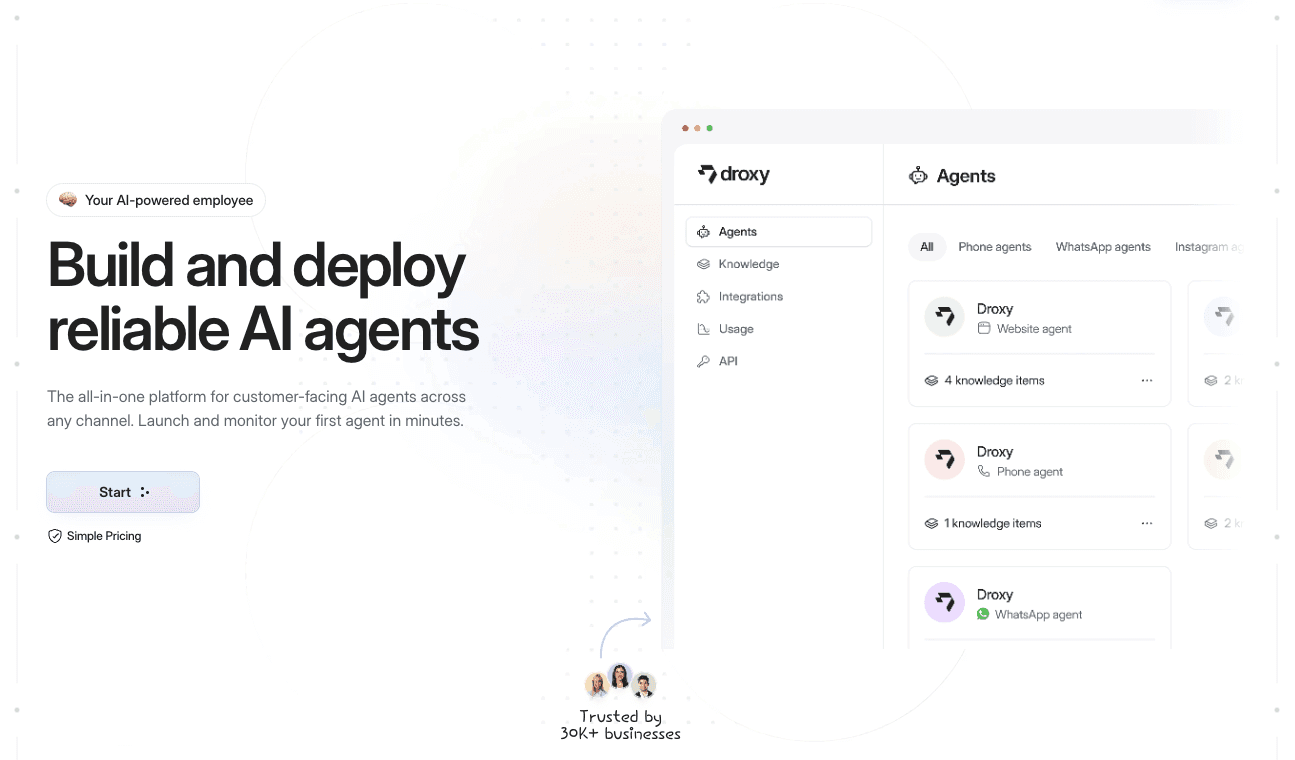
Droxy is a no-code platform for building these agents. You deploy them on website chat, phone, WhatsApp, Instagram, Facebook and Shopify, so the customer can reach you on whichever channel they prefer instead of defaulting to email. Here is how that maps to the work of reducing email:
Knowledge from multiple sources. The agent draws on the content you already have, so the answers match your policies.
Deep customization. You shape the agent so interactions stay human-like and match your brand’s voice.
Multilingual support. One agent can serve customers in more than one language.
Lead capture and appointment booking. A visitor who would have emailed “Do you have time Thursday?” can book directly.
Integrations. Droxy connects with existing systems through API and Zapier, so answers and actions fit your current workflow.
If you are weighing what kind of tool to use, our explainer on the difference between an AI agent and a chatbot covers what each can do. For a closer look at how a website deployment works, see the AI powered Website agent.
Tell customers they are talking to AI
Transparency helps. COPC Research found that customers told they were interacting with AI reported satisfaction 34 percentage points higher than those who were not told. A short, friendly line at the start of the conversation, such as “I’m the virtual assistant for your business name. I can help with orders, bookings and questions, and I can bring in a teammate any time,” sets the right expectation.
Step 4: Hand complex cases to a person, with context
A good automation plan does not try to answer everything. It answers the routine and passes the rest along. The academic research on chatbots and human agents agrees that human agents remain important for complex and emotionally charged interactions, and that hybrid models work best when escalation is built in.
The weak point in most setups is the handoff itself. COPC highlights that in AI-to-human transfers, data and context are often lost, which forces the customer to repeat everything. Design for this from day one:
Decide your triggers. Refund disputes, medical concerns, complaints, high-value orders and any message where the customer asks for a person should route to your team.
Pass the whole conversation. Your team member should see what the customer asked and what the agent answered.
Set expectations. Tell the customer who is coming and roughly when.
Route by topic. Droxy offers human hand-off and smart routing, so billing questions can go to one person and bookings to another.
For the mechanics, see our guide to chatbot human handoff. If you are still deciding how automated and human support should split the work, this piece on the role of chatbots in business is a helpful companion.
One research finding is worth knowing as you plan staffing. A study on hybrid service agents found that when human involvement is disclosed, customers shift to a more human style of communication, which sends more requests to staff. Plan for a team that handles fewer but more meaningful conversations, and keep your agent’s wording clear about what it can resolve.
What this looks like in your industry
The pattern is the same everywhere: tag, fix, automate, escalate. The details differ.
Ecommerce
Order status, returns and product questions dominate. An agent on your site and Shopify store can answer shipping and returns questions and make product recommendations, so shoppers get what they need before they abandon the cart or write in.
Hospitality
Guests ask about availability, check-in and policies, often outside office hours. A WhatsApp or website agent answers at any hour and can take booking requests, which moves booking efficiency up while the inbox shrinks.
Home services
People want a price range, a service area and a time slot, usually while the problem is happening. A phone or chat agent can capture the job details and book an appointment, so urgent requests are not left in an email queue overnight.
Real estate
Buyers message many agents at once, and the first response often wins. An agent that replies instantly, captures contact details and books viewings turns email inquiries into scheduled conversations.
Healthcare practices
Patients ask about hours, forms, insurance and appointments around the clock. An agent can handle those logistics while clinical questions go straight to staff. Keep medical advice out of the automated flow: configure the agent to route anything clinical to your team or to emergency services, never to answer it.
Agencies and consultants
If you manage support for clients, the same method becomes a repeatable service. Droxy lets agencies create unlimited white-labeled agents, manage branding and control client access from one platform. Bain’s advice for client deployments is to document requirements, estimate effort and sequence quick wins, which gives you a clean onboarding template for each new client.
Measure whether email volume is really dropping
A falling email count is only good news if customers are still well served. Track a small set of numbers every month:
Metric | What it tells you |
|---|---|
Emails per 100 orders, bookings or customers | Volume relative to growth, not raw counts |
Share of emails by inquiry tag | Whether your top tags are shrinking |
First response time | Whether customers wait less |
Resolution without human help | How much the agent handles end to end |
Handoff rate and repeat contacts | Whether escalations are clean |
Customer satisfaction after AI and human conversations | Whether quality holds |
Satisfaction is the number to watch closely. COPC found that 74% of global customers were satisfied with their most recent AI interaction, and satisfaction exceeded 90% when the AI fully resolved the issue without further steps. That tells you where to aim: configure your agent so routine questions are fully resolved in the conversation, not half answered.
Look beyond closure rates too. Emarketer’s coverage of a 2026 Gladly report notes that tracking ticket closure alone can miss the emotional side of the experience. Add a one-question rating after each conversation and read a sample of transcripts every week. Warm, specific wording earns loyalty.
Proactive communication can help here as well. Metrigy’s 2025 research found that companies using AI-powered proactive communications reported a Net Promoter Score of 61.3 against an industry average of 57.0.
Review monthly, adjust the agent’s knowledge where it falls short, and repeat the tagging exercise each quarter. New questions appear as your business changes.
Our perspective
Email volume is rarely a staffing problem. It is a timing problem. A customer has a question at 9 p.m., the answer exists somewhere on your site, and the only visible path to it is a contact form. By the time you reply the next morning, they have either found it elsewhere or left.
That is why we build Droxy around instant answers on the channels people already use: website chat, phone, WhatsApp, Instagram, Facebook and Shopify. When the agent knows your business through your own content, matches your voice and can book, capture leads or hand off to a person, the email never needs to be written.
Our advice is to start narrow. Pick the three inquiry types that fill your inbox, deploy one agent for them, and read the conversations. You will learn more about your customers in a week than a year of email replies taught you. Then expand to more channels and more topics.
Our formula is designed to keep the human in the loop: the agent handles the repetition, and your team handles the moments where a person makes the difference.
Elena
Start with one agent on your busiest channel
Droxy plans start with Basic from $16 per month, Advanced from $80 per month and Enterprise from $240 per month, and you can compare them on the Droxy pricing page. Most teams begin with the channel that produces the most emails, whether that is the website, WhatsApp or Instagram, and add others as the inbox quiets down.
If your customers also call, the AI powered Phone agent brings the same instant answers to voice. You can get started with Droxy and have your first agent answering questions without writing code.
FAQ
How long does it take to see email volume drop?
Fixing unclear content and policies can reduce emails within weeks, because the effect starts as soon as customers see the new information. An AI agent begins deflecting routine questions from the day it goes live. Give each change a full month of data before judging it, and compare emails per 100 orders or bookings rather than raw totals.
Will customers be frustrated by an AI agent?
Most are satisfied when the agent actually resolves their issue. COPC research found satisfaction above 90% when AI fully resolved a problem without further steps, and higher satisfaction when customers were told they were talking to AI. Be open about it, keep answers specific and make it easy to reach a person.
Which emails should I never automate?
Route complaints, refund disputes, high-value orders and anything involving health, safety or legal matters to a person. For healthcare practices, clinical questions should go to your clinicians, and urgent symptoms should be directed to emergency services. The agent’s job is to recognize these cases quickly and pass them on with the full conversation.
Can an agency run this for several clients?
Yes. Droxy supports white-labeling, so agencies can create unlimited agents under their own brand, manage branding and control each client’s access from one platform. Using the same tagging, fixing, automating and measuring routine for every client keeps results consistent.
What should I measure first?
Start with emails per 100 orders, bookings or customers, plus the share of your top inquiry tags. Add first response time and a satisfaction rating after each conversation. Together they show whether volume is falling and whether service quality is holding.
Sources
Minimize the Need for Customer Service to Improve the Omnichannel UX, Nielsen Norman Group
Three Key Pillars to Reimagine Customer Service and Support, Gartner
How to build self-service experiences that reduce tickets, Guideflow
AI customer service resolves issues but fails to build brand loyalty, Emarketer
Recommended
The fastest way to reduce email support volume is to stop the emails customers should never have needed to send. Find the questions that repeat, fix the information gaps behind them, and let an AI agent answer routine questions instantly on the channels your customers already use. Anything complex or sensitive goes to a person, with the conversation attached. Done in that order, your inbox shrinks and customers get answers faster.
This guide walks through that plan step by step, with the evidence behind each step and examples for ecommerce, hospitality, home services, real estate, healthcare and agencies.
Droxydroxy.aiAnswer Routine Questions InstantlyDroxy lets businesses deploy AI agents across chat, phone, and social channels to answer customer questions around the clock.Visit
TL;DR
Most contacts are avoidable: in one study of customer journeys, missing information caused 38% of direct contacts.
Start by tagging a month of emails by inquiry type. The top five types usually show you where to fix content, checkout or booking flows.
Put an AI agent on chat, WhatsApp, Instagram, Facebook, phone and your site so routine questions never turn into emails.
Keep a clean handoff to a human for complex or emotional cases, and measure resolution and satisfaction, not only ticket counts.
Table of Contents
Why most support emails are avoidable
Step 1: Sort your inbox by inquiry type
Step 2: Fix the source of the question
Step 3: Answer routine questions instantly with an AI agent
Step 4: Hand complex cases to a person, with context
What this looks like in your industry
Measure whether email volume is really dropping
Our perspective
Start with one agent on your busiest channel
Sources
Why most support emails are avoidable
A support email is usually a symptom. The customer could not find something, something went wrong, or a process felt harder than expected. Nielsen Norman Group looked at 45 medium-complex customer journeys and found that 64% included at least one contact the customer started themselves. In that research, missing information accounted for 38% of contacts, service problems and roadblocks for 24% each, and perceived complexity for 14%.
Read that as a to-do list. More than a third of contacts come from information the customer could not find at the moment they needed it. That is the cheapest category to remove, because you do not need more agents. You need the answer to be in front of the customer sooner.
Gartner makes the same point for service leaders: support works better when it removes unnecessary interactions by addressing root causes rather than staffing up to absorb them. Replying faster to every email is a treadmill. Preventing the email is the exit.
Step 1: Sort your inbox by inquiry type
Before you change anything, you need to know what is in the inbox. Export or review the last 30 to 90 days of support emails and tag each one with a single primary reason. Keep the tags simple and specific to your business. Typical examples:
Ecommerce: where is my order, return or exchange policy, sizing, discount codes, shipping costs and times.
Hospitality: availability, check-in times, cancellation rules, parking, dietary needs.
Home services: pricing ranges, service areas, appointment windows, emergency availability.
Real estate: is the listing still available, viewing times, financing questions, neighborhood details.
Healthcare practices: opening hours, new patient forms, insurance accepted, appointment changes.
Then count. In most inboxes a handful of tags make up the bulk of the volume. Those are your targets. Also mark which emails were really a second attempt, where the customer wrote again because the first answer was slow or unclear. Those repeats are the clearest sign of a gap.
This tagging exercise is manual the first time. Once an AI agent is handling conversations, the same exercise becomes ongoing: the questions it sees most often show you what your site and policies fail to say clearly. Droxy includes analytics for exactly this kind of review.
Step 2: Fix the source of the question
Some of your top tags come from a broken or unclear experience, not from curiosity. Fix those first, because no amount of fast answering beats a question that never arises.
Put the answer where the question forms. If customers email about shipping times, the answer belongs on the product page and in the cart, not only on a help page. One company blog argues that embedding self-service content in the customer’s workflow can cut ticket volume by 20% to 40%, which fits the logic: the closer the answer is to the moment of doubt, the fewer emails you receive.
Remove roadblocks. If a form rejects valid entries or a booking page does not confirm, customers will write in. Fixing one defect can remove an entire tag from your list. Our guide on fixing the product first to reduce support tickets goes deeper on this approach.
Simplify what feels complicated. Perceived complexity drove 14% of contacts in the research above. Plain-language policies, short checklists and clear next steps lower that number.
Update customers before they ask. Order status, appointment reminders and delay notices answer the question in advance. Keep these messages short and specific so they do not generate replies of their own.
Bain’s customer-experience playbook recommends a sound way to organize this work: map the customer episode, document business and technical requirements, then sequence quick wins ahead of longer-term changes. Fixing a policy page is a quick win. Rebuilding a returns process is a longer one. Do both, in that order.
Step 3: Answer routine questions instantly with an AI agent
After you fix what you can at the source, many questions will still come in, and they will be repetitive. This is where an AI agent earns its place. Instead of a customer writing an email and waiting hours, they ask on your website, WhatsApp, Instagram or Facebook and get an answer in seconds.
Speed is the clearest advantage. A 2025 study of 1,500 survey responses comparing AI chatbots with human agents found an average response time of 2.1 seconds for AI bots against 45 seconds for humans. The same paper notes that AI handles repetitive queries such as FAQs well, which is exactly the profile of your top inquiry tags.
Droxy is a no-code platform for building these agents. You deploy them on website chat, phone, WhatsApp, Instagram, Facebook and Shopify, so the customer can reach you on whichever channel they prefer instead of defaulting to email. Here is how that maps to the work of reducing email:
Knowledge from multiple sources. The agent draws on the content you already have, so the answers match your policies.
Deep customization. You shape the agent so interactions stay human-like and match your brand’s voice.
Multilingual support. One agent can serve customers in more than one language.
Lead capture and appointment booking. A visitor who would have emailed “Do you have time Thursday?” can book directly.
Integrations. Droxy connects with existing systems through API and Zapier, so answers and actions fit your current workflow.
If you are weighing what kind of tool to use, our explainer on the difference between an AI agent and a chatbot covers what each can do. For a closer look at how a website deployment works, see the AI powered Website agent.
Tell customers they are talking to AI
Transparency helps. COPC Research found that customers told they were interacting with AI reported satisfaction 34 percentage points higher than those who were not told. A short, friendly line at the start of the conversation, such as “I’m the virtual assistant for your business name. I can help with orders, bookings and questions, and I can bring in a teammate any time,” sets the right expectation.
Step 4: Hand complex cases to a person, with context
A good automation plan does not try to answer everything. It answers the routine and passes the rest along. The academic research on chatbots and human agents agrees that human agents remain important for complex and emotionally charged interactions, and that hybrid models work best when escalation is built in.
The weak point in most setups is the handoff itself. COPC highlights that in AI-to-human transfers, data and context are often lost, which forces the customer to repeat everything. Design for this from day one:
Decide your triggers. Refund disputes, medical concerns, complaints, high-value orders and any message where the customer asks for a person should route to your team.
Pass the whole conversation. Your team member should see what the customer asked and what the agent answered.
Set expectations. Tell the customer who is coming and roughly when.
Route by topic. Droxy offers human hand-off and smart routing, so billing questions can go to one person and bookings to another.
For the mechanics, see our guide to chatbot human handoff. If you are still deciding how automated and human support should split the work, this piece on the role of chatbots in business is a helpful companion.
One research finding is worth knowing as you plan staffing. A study on hybrid service agents found that when human involvement is disclosed, customers shift to a more human style of communication, which sends more requests to staff. Plan for a team that handles fewer but more meaningful conversations, and keep your agent’s wording clear about what it can resolve.
What this looks like in your industry
The pattern is the same everywhere: tag, fix, automate, escalate. The details differ.
Ecommerce
Order status, returns and product questions dominate. An agent on your site and Shopify store can answer shipping and returns questions and make product recommendations, so shoppers get what they need before they abandon the cart or write in.
Hospitality
Guests ask about availability, check-in and policies, often outside office hours. A WhatsApp or website agent answers at any hour and can take booking requests, which moves booking efficiency up while the inbox shrinks.
Home services
People want a price range, a service area and a time slot, usually while the problem is happening. A phone or chat agent can capture the job details and book an appointment, so urgent requests are not left in an email queue overnight.
Real estate
Buyers message many agents at once, and the first response often wins. An agent that replies instantly, captures contact details and books viewings turns email inquiries into scheduled conversations.
Healthcare practices
Patients ask about hours, forms, insurance and appointments around the clock. An agent can handle those logistics while clinical questions go straight to staff. Keep medical advice out of the automated flow: configure the agent to route anything clinical to your team or to emergency services, never to answer it.
Agencies and consultants
If you manage support for clients, the same method becomes a repeatable service. Droxy lets agencies create unlimited white-labeled agents, manage branding and control client access from one platform. Bain’s advice for client deployments is to document requirements, estimate effort and sequence quick wins, which gives you a clean onboarding template for each new client.
Measure whether email volume is really dropping
A falling email count is only good news if customers are still well served. Track a small set of numbers every month:
Metric | What it tells you |
|---|---|
Emails per 100 orders, bookings or customers | Volume relative to growth, not raw counts |
Share of emails by inquiry tag | Whether your top tags are shrinking |
First response time | Whether customers wait less |
Resolution without human help | How much the agent handles end to end |
Handoff rate and repeat contacts | Whether escalations are clean |
Customer satisfaction after AI and human conversations | Whether quality holds |
Satisfaction is the number to watch closely. COPC found that 74% of global customers were satisfied with their most recent AI interaction, and satisfaction exceeded 90% when the AI fully resolved the issue without further steps. That tells you where to aim: configure your agent so routine questions are fully resolved in the conversation, not half answered.
Look beyond closure rates too. Emarketer’s coverage of a 2026 Gladly report notes that tracking ticket closure alone can miss the emotional side of the experience. Add a one-question rating after each conversation and read a sample of transcripts every week. Warm, specific wording earns loyalty.
Proactive communication can help here as well. Metrigy’s 2025 research found that companies using AI-powered proactive communications reported a Net Promoter Score of 61.3 against an industry average of 57.0.
Review monthly, adjust the agent’s knowledge where it falls short, and repeat the tagging exercise each quarter. New questions appear as your business changes.
Our perspective
Email volume is rarely a staffing problem. It is a timing problem. A customer has a question at 9 p.m., the answer exists somewhere on your site, and the only visible path to it is a contact form. By the time you reply the next morning, they have either found it elsewhere or left.
That is why we build Droxy around instant answers on the channels people already use: website chat, phone, WhatsApp, Instagram, Facebook and Shopify. When the agent knows your business through your own content, matches your voice and can book, capture leads or hand off to a person, the email never needs to be written.
Our advice is to start narrow. Pick the three inquiry types that fill your inbox, deploy one agent for them, and read the conversations. You will learn more about your customers in a week than a year of email replies taught you. Then expand to more channels and more topics.
Our formula is designed to keep the human in the loop: the agent handles the repetition, and your team handles the moments where a person makes the difference.
Elena
Start with one agent on your busiest channel
Droxy plans start with Basic from $16 per month, Advanced from $80 per month and Enterprise from $240 per month, and you can compare them on the Droxy pricing page. Most teams begin with the channel that produces the most emails, whether that is the website, WhatsApp or Instagram, and add others as the inbox quiets down.
If your customers also call, the AI powered Phone agent brings the same instant answers to voice. You can get started with Droxy and have your first agent answering questions without writing code.
FAQ
How long does it take to see email volume drop?
Fixing unclear content and policies can reduce emails within weeks, because the effect starts as soon as customers see the new information. An AI agent begins deflecting routine questions from the day it goes live. Give each change a full month of data before judging it, and compare emails per 100 orders or bookings rather than raw totals.
Will customers be frustrated by an AI agent?
Most are satisfied when the agent actually resolves their issue. COPC research found satisfaction above 90% when AI fully resolved a problem without further steps, and higher satisfaction when customers were told they were talking to AI. Be open about it, keep answers specific and make it easy to reach a person.
Which emails should I never automate?
Route complaints, refund disputes, high-value orders and anything involving health, safety or legal matters to a person. For healthcare practices, clinical questions should go to your clinicians, and urgent symptoms should be directed to emergency services. The agent’s job is to recognize these cases quickly and pass them on with the full conversation.
Can an agency run this for several clients?
Yes. Droxy supports white-labeling, so agencies can create unlimited agents under their own brand, manage branding and control each client’s access from one platform. Using the same tagging, fixing, automating and measuring routine for every client keeps results consistent.
What should I measure first?
Start with emails per 100 orders, bookings or customers, plus the share of your top inquiry tags. Add first response time and a satisfaction rating after each conversation. Together they show whether volume is falling and whether service quality is holding.
Sources
Minimize the Need for Customer Service to Improve the Omnichannel UX, Nielsen Norman Group
Three Key Pillars to Reimagine Customer Service and Support, Gartner
How to build self-service experiences that reduce tickets, Guideflow
AI customer service resolves issues but fails to build brand loyalty, Emarketer
Recommended


🚀
Powered by Droxy
Turn every interaction into a conversion
Customer facing AI agents that engage, convert, and support so you can scale what matters.
✨
Learn more
Recent posts
Insights
3 min read
Introducing Agent Memories
Improve your agents' performance with Agent Memories. Prevent agents from repeating the same mistakes by giving them feedback.
Read more

Insights
15 min read
HVAC Marketing in 2025: The Definitive Lead Gen Guide
Discover 15 proven HVAC marketing strategies, plus learn how Droxy's AI website agent converts curious visitors into qualified leads by answering their questions instantly - right when they're most interested in your services.
Read more
Insights
10 min read
10 Best AI Sales Agents in 2025: Tested & Ranked
Discover the top 10 AI sales agents of 2025, designed to enhance lead generation, personalize outreach, and ultimately, close more deals
Read more
Insights
3 min read
Introducing Agent Memories
Improve your agents' performance with Agent Memories. Prevent agents from repeating the same mistakes by giving them feedback.
Read more
Insights
15 min read
HVAC Marketing in 2025: The Definitive Lead Gen Guide
Discover 15 proven HVAC marketing strategies, plus learn how Droxy's AI website agent converts curious visitors into qualified leads by answering their questions instantly - right when they're most interested in your services.
Read more