How to Reduce First Response Time: Benchmarks and 7 Fixes
How to Reduce First Response Time: Benchmarks and 7 Fixes
Insights
14 min

To reduce first response time, do three things in order: measure it by channel, remove the waiting that happens before a human even sees the message, and let automation give an instant first reply on the channels where customers expect one. The rest of this guide shows you how, with benchmarks to aim for and a plan you can start this week.
First response time (FRT) is the gap between a customer reaching out and your first real reply. It is not the time to resolve the problem. That makes it the fastest metric to improve, and often the one customers notice most.
DroxyAnswer Customer Inquiries InstantlyDroxy deploys AI agents across chat, phone, and social channels to answer customer inquiries instantly, 24/7, and reduce wait times.Explore Droxy
TL;DR
Customers expect different speeds by channel: 66% of live chat users expect a reply within 5 minutes, while most email users will wait up to a day.
Most delay is queue time, not typing time. Fix routing, coverage hours and repetitive questions before you hire.
An AI agent that answers instantly, 24/7, and hands off to a person when needed is the quickest way to bring FRT down on chat, social and phone.
Measure FRT per channel and per hour of day, and review it weekly.
Table of Contents
What first response time actually measures
First response time benchmarks by channel
Why slow first replies cost you customers
Where the waiting actually happens
Seven ways to improve first response time
A simple 30-day plan
Our perspective: speed first, then depth
Where Droxy fits
Mistakes that keep response times high
Sources
What first response time actually measures
FRT starts when the customer sends a message, calls, or submits a form. It stops when they get a meaningful reply from you. Three details decide whether your number is honest:
Auto-acknowledgments. A “we got your message” email is a courtesy, not a response. Track it separately, or your FRT will look better than the customer’s experience.
Business hours vs. calendar hours. If a message arrives Friday at 6 p.m. and you answer Monday at 9 a.m., the customer waited 63 hours, whatever your dashboard says. Report both.
Channel. Averaging chat, email and social together hides the problems. Chat at 4 minutes and email at 10 hours produce a meaningless average.
The simple formula: add up the time to first reply for every conversation in a period, then divide by the number of conversations. Look at the median as well. A handful of messages that sat overnight can distort the average badly.
First response time benchmarks by channel
There is no single “good” number. The right target depends on where the customer reached you and what they expect there.
Channel | What customers expect | A realistic target |
|---|---|---|
Live chat | A reply within minutes, often seconds | Under 1 minute |
Social messaging (Instagram, Facebook) | Within an hour | Under 15 minutes |
Conversational, near-instant | Under 2 minutes | |
Phone | Answered, not a voicemail | Answered on the first ring cycle or a call-back promise |
Within 24 hours | Under 1 hour for sales, under 4 for support |
The expectation column comes from research on customer expectations: 66% of live chat users expect a response within 5 minutes, 52% of digital-channel users expect one within an hour, and 94% of email users expect one within 24 hours. The target column is our recommended goal for small and mid-sized teams, not a published industry standard. Treat it as a starting line and adjust to your own customers.
One more reason to aim higher than the minimum: 51% of customers wait less than an hour before trying another way to reach a company if nobody answers. A slow reply on chat often becomes a second ticket by email and a third by phone, which raises your workload as well as the customer’s irritation.
Why slow first replies cost you customers
The same research reports that 43% of shoppers name slow response times as a top frustration, and that 86% of consumers say they will leave a brand after two to three poor experiences. Those are survey findings, so read them as direction rather than a guarantee. But the pattern matches what most owners see: the first reply sets the tone.
The damage differs by business type:
Ecommerce: a shopper asking about sizing or shipping at 11 p.m. is deciding right now. If nobody answers, a competitor’s tab is one click away.
Home services: someone with a leaking pipe calls the first two companies they find. The one that picks up wins the job.
Real estate: a new listing inquiry cools quickly. The agent who replies first usually gets the conversation.
Hospitality: booking questions that wait until morning often turn into bookings elsewhere.
Healthcare practices: patients asking about appointments or hours expect a clear answer outside office hours.
Speed also protects loyalty. If you want to go deeper on keeping customers once you win them, these customer retention strategies are a good next read. And there is a human side: in a UK retail study, 3 in 5 online shoppers reported difficulty reaching a human agent when they needed help. Fast does not have to mean robotic, but it does have to mean reachable.
Where the waiting actually happens
Before you change anything, find out where the minutes go. In most small teams, the delay sits in one of four places.
Off-hours gaps. Nights, weekends and lunch breaks produce the longest waits. They are also invisible if you only look at averages.
Scattered inboxes. Messages arrive on a website form, Instagram, Facebook, WhatsApp and a phone line. Someone has to check each one.
Wrong-queue handoffs. A message lands with the wrong person, sits, then gets forwarded.
Repeat questions. Opening hours, shipping times, pricing, “do you service my area?” These make up a large share of volume and each one takes a person away from harder work.
Pull a week of conversations and tag each one by channel, time of day and topic. You will likely find that a few topics and a few time windows account for most of the slow replies. That is where to start.
Seven ways to improve first response time
1. Put every channel in one place
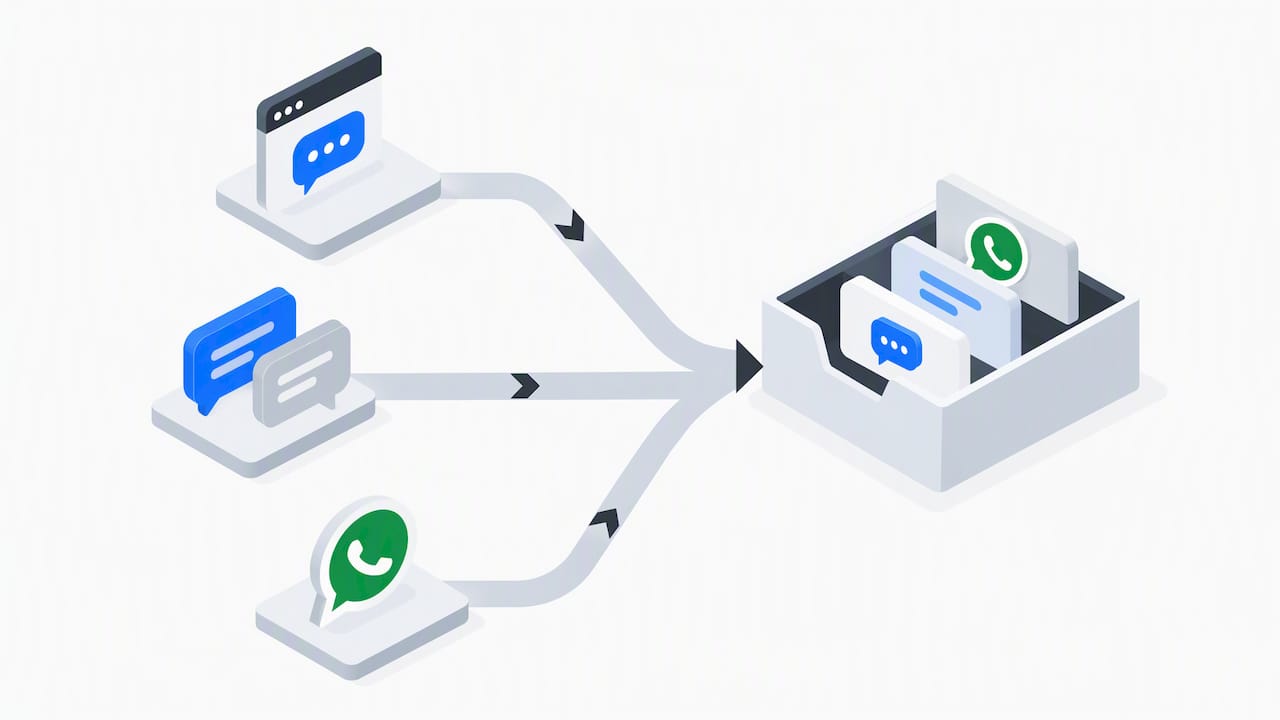
A unified inbox removes the “nobody checked Instagram” problem. Even before you add automation, route website chat, social messages and WhatsApp into one view so a single person, or a single AI agent, sees everything.
2. Route by topic and urgency
Messages that land in the wrong queue wait longer. Routing and triage at intake is one of the levers that tends to move FRT most. Sort sales questions, booking requests and urgent problems automatically, and send each to the right person. If you run a physical queue as well as a digital one, these queue management features show how the same logic applies to reducing waits on site.
3. Answer the repeat questions instantly
List your top 20 questions and write clear answers. Hours, pricing, delivery, returns, service areas, how to book. Once those answers exist, software can deliver them in seconds at any hour. This also helps your ticket volume: our guide on cutting support tickets covers how to prevent many questions from arriving at all.
4. Add an AI agent for the first reply
This is the biggest single change for most small businesses. An AI agent can greet the visitor, answer from your own knowledge, capture contact details, book an appointment and pass the conversation to a person when it should. If you are unsure what separates an agent from a basic chatbot, read our explainer on AI agents versus chatbots.
5. Keep a human in the loop
Do not treat AI as a wall between you and your customers. Research from Comcast on an agent-facing assistant found that giving human agents real-time AI help reduced average handle time by roughly 10% in a large enterprise setting. That is a different use case from customer-facing automation, and a different scale from yours, but the lesson carries over: the best setups pair fast machine answers with clear human escalation.
6. Set staffing around your busiest hours
Use the time-of-day data you collected. If 40% of slow replies cluster between 5 and 8 p.m., shift one person’s hours or add automation to cover that window, rather than hiring a full extra person.
7. Review the number weekly
Put FRT per channel on one page. Look at the median, the 90th percentile and the slowest ten conversations. Ask why each of those was slow. Small fixes, repeated weekly, compound.
A simple 30-day plan
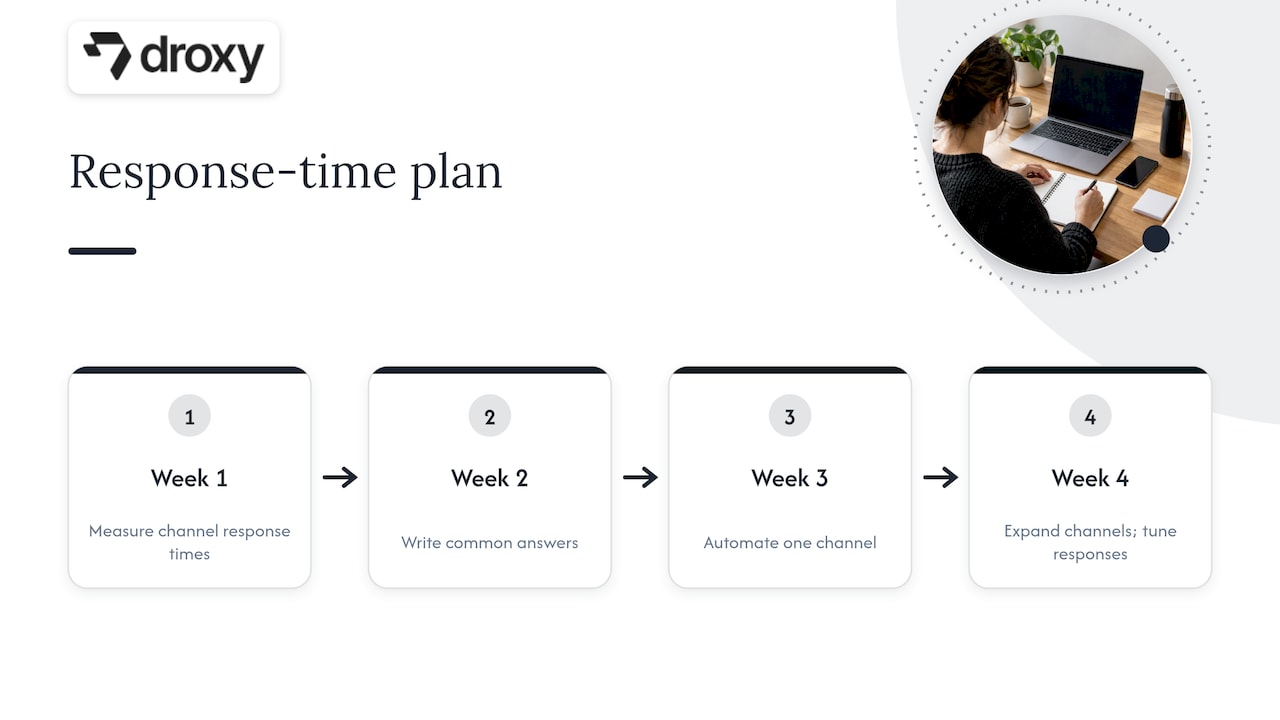
Week 1: Measure. Export conversations from every channel. Calculate median FRT per channel, both in business hours and calendar hours.
Week 2: Write. Draft answers to your 20 most common questions. Mark which ones need a human (refunds, complaints, medical or legal specifics).
Week 3: Automate. Connect your knowledge sources to an AI agent, set the voice and handoff rules, and switch it on for one channel, usually website chat.
Week 4: Expand and tune. Read the transcripts. Fix wrong or vague answers. Add WhatsApp, Instagram or Facebook if the data shows demand there.
A worked example: a home services company gets 30 inquiries a day, a third of them after 5 p.m. Before automation, those evening messages wait about 14 hours on average. With an instant first reply that collects the address, the problem and a preferred time, the customer gets an answer in seconds and the team starts the morning with qualified leads. The overnight waiting time falls from hours to seconds, and the human work shifts to the conversation that actually needs a person. (This is an illustration of the mechanics, not a customer result.)
Our perspective: speed first, then depth
We build Droxy because we believe the first reply is where most businesses lose people they never knew they had. A missed inquiry does not show up as a complaint. It just never turns into a customer.
Here is what we have learned from working on AI agents for customer interaction:
Instant does not have to feel cold. Customization matters. When the agent speaks in your brand’s voice and answers from your own documents, customers get a reply that sounds like your business, not a generic bot.
Channels should not be silos. Customers start on Instagram, move to WhatsApp, then call. The agent should work wherever they are, and your team should see the whole picture.
Hand-off is a feature, not a failure. Some questions need a person. The best experience is an agent that knows its limits, gathers context and passes the conversation along so the customer never has to repeat themselves.
Measure what matters. Analytics on response times and conversation topics tell you what to improve next, and show you which questions you could answer before they are asked.
If you do only one thing after reading this, tag a week of conversations by time of day. The pattern will tell you whether you have a staffing problem, a routing problem or a coverage problem. Then fix that one first.
— Elena
Where Droxy fits
Droxy is a no-code platform for deploying AI agents that reply instantly, around the clock. You can run them on website chat, phone, WhatsApp, Instagram, Facebook and Shopify, with multilingual support, lead capture, appointment booking, smart routing and human hand-off. It connects to your existing systems through API and Zapier.
Start with the channel where your slowest replies happen:
Website agent for chat visitors
Phone agent for calls you miss
WhatsApp agent for conversational support
Instagram agent and Facebook agent for social inquiries
Plans start at $16 per month for Basic, $80 per month for Advanced and $240 per month for Enterprise, all listed on the Droxy pricing page. Agencies that want to offer this to clients under their own brand can look at the agency option.
Mistakes that keep response times high
Measuring only the average. The slowest 10% of conversations are the ones customers remember.
Counting auto-replies as responses. It flatters the dashboard and fools nobody else.
Automating before cleaning up your answers. An agent is only as good as the knowledge you give it. Review your documents first.
Hiding the human option. Customers want a way to reach a person. Offer it clearly.
Setting and forgetting. Read transcripts for the first few weeks and update answers as your offers change.
For more on how these systems work under the hood, see our overview of how conversational AI works, and for practical use cases, examples of AI in customer service.
FAQ
What is a good first response time?
It depends on the channel. For live chat, aim for under a minute, since most chat users expect an answer within minutes. For email, under an hour is a strong target for sales and a few hours for support. Set a separate goal for each channel rather than one blended number.
How do I improve first response time without hiring more people?
Start with routing and repeat questions. Send each message to the right person automatically, and let an AI agent answer the common questions instantly. Then use your time-of-day data to cover the hours where waits are longest. Most teams cut their number noticeably before they need another hire.
Will an AI agent make customers feel ignored?
Not if it is set up well. A customized agent that uses your own knowledge, speaks in your voice and hands off to a person when a question needs one tends to feel responsive rather than robotic. In a HubSpot-style chat survey many consumers say they want a human available, so always make that route clear.
Is first response time the same as resolution time?
No. FRT measures only how long until the first reply. Resolution time measures how long until the issue is solved. Improve FRT first because it is faster to change, then work on resolution through better knowledge and training.
Sources
First response time benchmarks and customer expectations, Stealth Agents
Ask Me Anything: How Comcast Uses LLMs to Assist Agents in Real Time, arXiv
What UK Shoppers Want from the Retail Customer Experience, Whistl
Recommended
To reduce first response time, do three things in order: measure it by channel, remove the waiting that happens before a human even sees the message, and let automation give an instant first reply on the channels where customers expect one. The rest of this guide shows you how, with benchmarks to aim for and a plan you can start this week.
First response time (FRT) is the gap between a customer reaching out and your first real reply. It is not the time to resolve the problem. That makes it the fastest metric to improve, and often the one customers notice most.
DroxyAnswer Customer Inquiries InstantlyDroxy deploys AI agents across chat, phone, and social channels to answer customer inquiries instantly, 24/7, and reduce wait times.Explore Droxy
TL;DR
Customers expect different speeds by channel: 66% of live chat users expect a reply within 5 minutes, while most email users will wait up to a day.
Most delay is queue time, not typing time. Fix routing, coverage hours and repetitive questions before you hire.
An AI agent that answers instantly, 24/7, and hands off to a person when needed is the quickest way to bring FRT down on chat, social and phone.
Measure FRT per channel and per hour of day, and review it weekly.
Table of Contents
What first response time actually measures
First response time benchmarks by channel
Why slow first replies cost you customers
Where the waiting actually happens
Seven ways to improve first response time
A simple 30-day plan
Our perspective: speed first, then depth
Where Droxy fits
Mistakes that keep response times high
Sources
What first response time actually measures
FRT starts when the customer sends a message, calls, or submits a form. It stops when they get a meaningful reply from you. Three details decide whether your number is honest:
Auto-acknowledgments. A “we got your message” email is a courtesy, not a response. Track it separately, or your FRT will look better than the customer’s experience.
Business hours vs. calendar hours. If a message arrives Friday at 6 p.m. and you answer Monday at 9 a.m., the customer waited 63 hours, whatever your dashboard says. Report both.
Channel. Averaging chat, email and social together hides the problems. Chat at 4 minutes and email at 10 hours produce a meaningless average.
The simple formula: add up the time to first reply for every conversation in a period, then divide by the number of conversations. Look at the median as well. A handful of messages that sat overnight can distort the average badly.
First response time benchmarks by channel
There is no single “good” number. The right target depends on where the customer reached you and what they expect there.
Channel | What customers expect | A realistic target |
|---|---|---|
Live chat | A reply within minutes, often seconds | Under 1 minute |
Social messaging (Instagram, Facebook) | Within an hour | Under 15 minutes |
Conversational, near-instant | Under 2 minutes | |
Phone | Answered, not a voicemail | Answered on the first ring cycle or a call-back promise |
Within 24 hours | Under 1 hour for sales, under 4 for support |
The expectation column comes from research on customer expectations: 66% of live chat users expect a response within 5 minutes, 52% of digital-channel users expect one within an hour, and 94% of email users expect one within 24 hours. The target column is our recommended goal for small and mid-sized teams, not a published industry standard. Treat it as a starting line and adjust to your own customers.
One more reason to aim higher than the minimum: 51% of customers wait less than an hour before trying another way to reach a company if nobody answers. A slow reply on chat often becomes a second ticket by email and a third by phone, which raises your workload as well as the customer’s irritation.
Why slow first replies cost you customers
The same research reports that 43% of shoppers name slow response times as a top frustration, and that 86% of consumers say they will leave a brand after two to three poor experiences. Those are survey findings, so read them as direction rather than a guarantee. But the pattern matches what most owners see: the first reply sets the tone.
The damage differs by business type:
Ecommerce: a shopper asking about sizing or shipping at 11 p.m. is deciding right now. If nobody answers, a competitor’s tab is one click away.
Home services: someone with a leaking pipe calls the first two companies they find. The one that picks up wins the job.
Real estate: a new listing inquiry cools quickly. The agent who replies first usually gets the conversation.
Hospitality: booking questions that wait until morning often turn into bookings elsewhere.
Healthcare practices: patients asking about appointments or hours expect a clear answer outside office hours.
Speed also protects loyalty. If you want to go deeper on keeping customers once you win them, these customer retention strategies are a good next read. And there is a human side: in a UK retail study, 3 in 5 online shoppers reported difficulty reaching a human agent when they needed help. Fast does not have to mean robotic, but it does have to mean reachable.
Where the waiting actually happens
Before you change anything, find out where the minutes go. In most small teams, the delay sits in one of four places.
Off-hours gaps. Nights, weekends and lunch breaks produce the longest waits. They are also invisible if you only look at averages.
Scattered inboxes. Messages arrive on a website form, Instagram, Facebook, WhatsApp and a phone line. Someone has to check each one.
Wrong-queue handoffs. A message lands with the wrong person, sits, then gets forwarded.
Repeat questions. Opening hours, shipping times, pricing, “do you service my area?” These make up a large share of volume and each one takes a person away from harder work.
Pull a week of conversations and tag each one by channel, time of day and topic. You will likely find that a few topics and a few time windows account for most of the slow replies. That is where to start.
Seven ways to improve first response time
1. Put every channel in one place
A unified inbox removes the “nobody checked Instagram” problem. Even before you add automation, route website chat, social messages and WhatsApp into one view so a single person, or a single AI agent, sees everything.
2. Route by topic and urgency
Messages that land in the wrong queue wait longer. Routing and triage at intake is one of the levers that tends to move FRT most. Sort sales questions, booking requests and urgent problems automatically, and send each to the right person. If you run a physical queue as well as a digital one, these queue management features show how the same logic applies to reducing waits on site.
3. Answer the repeat questions instantly
List your top 20 questions and write clear answers. Hours, pricing, delivery, returns, service areas, how to book. Once those answers exist, software can deliver them in seconds at any hour. This also helps your ticket volume: our guide on cutting support tickets covers how to prevent many questions from arriving at all.
4. Add an AI agent for the first reply
This is the biggest single change for most small businesses. An AI agent can greet the visitor, answer from your own knowledge, capture contact details, book an appointment and pass the conversation to a person when it should. If you are unsure what separates an agent from a basic chatbot, read our explainer on AI agents versus chatbots.
5. Keep a human in the loop
Do not treat AI as a wall between you and your customers. Research from Comcast on an agent-facing assistant found that giving human agents real-time AI help reduced average handle time by roughly 10% in a large enterprise setting. That is a different use case from customer-facing automation, and a different scale from yours, but the lesson carries over: the best setups pair fast machine answers with clear human escalation.
6. Set staffing around your busiest hours
Use the time-of-day data you collected. If 40% of slow replies cluster between 5 and 8 p.m., shift one person’s hours or add automation to cover that window, rather than hiring a full extra person.
7. Review the number weekly
Put FRT per channel on one page. Look at the median, the 90th percentile and the slowest ten conversations. Ask why each of those was slow. Small fixes, repeated weekly, compound.
A simple 30-day plan
Week 1: Measure. Export conversations from every channel. Calculate median FRT per channel, both in business hours and calendar hours.
Week 2: Write. Draft answers to your 20 most common questions. Mark which ones need a human (refunds, complaints, medical or legal specifics).
Week 3: Automate. Connect your knowledge sources to an AI agent, set the voice and handoff rules, and switch it on for one channel, usually website chat.
Week 4: Expand and tune. Read the transcripts. Fix wrong or vague answers. Add WhatsApp, Instagram or Facebook if the data shows demand there.
A worked example: a home services company gets 30 inquiries a day, a third of them after 5 p.m. Before automation, those evening messages wait about 14 hours on average. With an instant first reply that collects the address, the problem and a preferred time, the customer gets an answer in seconds and the team starts the morning with qualified leads. The overnight waiting time falls from hours to seconds, and the human work shifts to the conversation that actually needs a person. (This is an illustration of the mechanics, not a customer result.)
Our perspective: speed first, then depth
We build Droxy because we believe the first reply is where most businesses lose people they never knew they had. A missed inquiry does not show up as a complaint. It just never turns into a customer.
Here is what we have learned from working on AI agents for customer interaction:
Instant does not have to feel cold. Customization matters. When the agent speaks in your brand’s voice and answers from your own documents, customers get a reply that sounds like your business, not a generic bot.
Channels should not be silos. Customers start on Instagram, move to WhatsApp, then call. The agent should work wherever they are, and your team should see the whole picture.
Hand-off is a feature, not a failure. Some questions need a person. The best experience is an agent that knows its limits, gathers context and passes the conversation along so the customer never has to repeat themselves.
Measure what matters. Analytics on response times and conversation topics tell you what to improve next, and show you which questions you could answer before they are asked.
If you do only one thing after reading this, tag a week of conversations by time of day. The pattern will tell you whether you have a staffing problem, a routing problem or a coverage problem. Then fix that one first.
— Elena
Where Droxy fits
Droxy is a no-code platform for deploying AI agents that reply instantly, around the clock. You can run them on website chat, phone, WhatsApp, Instagram, Facebook and Shopify, with multilingual support, lead capture, appointment booking, smart routing and human hand-off. It connects to your existing systems through API and Zapier.
Start with the channel where your slowest replies happen:
Website agent for chat visitors
Phone agent for calls you miss
WhatsApp agent for conversational support
Instagram agent and Facebook agent for social inquiries
Plans start at $16 per month for Basic, $80 per month for Advanced and $240 per month for Enterprise, all listed on the Droxy pricing page. Agencies that want to offer this to clients under their own brand can look at the agency option.
Mistakes that keep response times high
Measuring only the average. The slowest 10% of conversations are the ones customers remember.
Counting auto-replies as responses. It flatters the dashboard and fools nobody else.
Automating before cleaning up your answers. An agent is only as good as the knowledge you give it. Review your documents first.
Hiding the human option. Customers want a way to reach a person. Offer it clearly.
Setting and forgetting. Read transcripts for the first few weeks and update answers as your offers change.
For more on how these systems work under the hood, see our overview of how conversational AI works, and for practical use cases, examples of AI in customer service.
FAQ
What is a good first response time?
It depends on the channel. For live chat, aim for under a minute, since most chat users expect an answer within minutes. For email, under an hour is a strong target for sales and a few hours for support. Set a separate goal for each channel rather than one blended number.
How do I improve first response time without hiring more people?
Start with routing and repeat questions. Send each message to the right person automatically, and let an AI agent answer the common questions instantly. Then use your time-of-day data to cover the hours where waits are longest. Most teams cut their number noticeably before they need another hire.
Will an AI agent make customers feel ignored?
Not if it is set up well. A customized agent that uses your own knowledge, speaks in your voice and hands off to a person when a question needs one tends to feel responsive rather than robotic. In a HubSpot-style chat survey many consumers say they want a human available, so always make that route clear.
Is first response time the same as resolution time?
No. FRT measures only how long until the first reply. Resolution time measures how long until the issue is solved. Improve FRT first because it is faster to change, then work on resolution through better knowledge and training.
Sources
First response time benchmarks and customer expectations, Stealth Agents
Ask Me Anything: How Comcast Uses LLMs to Assist Agents in Real Time, arXiv
What UK Shoppers Want from the Retail Customer Experience, Whistl
Recommended


🚀
Powered by Droxy
Turn every interaction into a conversion
Customer facing AI agents that engage, convert, and support so you can scale what matters.
✨
Learn more
Recent posts
Insights
3 min read
Introducing Agent Memories
Improve your agents' performance with Agent Memories. Prevent agents from repeating the same mistakes by giving them feedback.
Read more

Insights
15 min read
HVAC Marketing in 2025: The Definitive Lead Gen Guide
Discover 15 proven HVAC marketing strategies, plus learn how Droxy's AI website agent converts curious visitors into qualified leads by answering their questions instantly - right when they're most interested in your services.
Read more
Insights
10 min read
10 Best AI Sales Agents in 2025: Tested & Ranked
Discover the top 10 AI sales agents of 2025, designed to enhance lead generation, personalize outreach, and ultimately, close more deals
Read more
Insights
3 min read
Introducing Agent Memories
Improve your agents' performance with Agent Memories. Prevent agents from repeating the same mistakes by giving them feedback.
Read more
Insights
15 min read
HVAC Marketing in 2025: The Definitive Lead Gen Guide
Discover 15 proven HVAC marketing strategies, plus learn how Droxy's AI website agent converts curious visitors into qualified leads by answering their questions instantly - right when they're most interested in your services.
Read more