Enterprise Multilingual Chatbot That Works Without a Dev Team
Enterprise Multilingual Chatbot That Works Without a Dev Team
Insights
14 min

A multilingual chatbot is a conversational system that detects, understands, and responds in more than one language, and the enterprise systems that hold up in production combine explicit language context in the prompt with a hybrid localization workflow. Platforms like Claude and Kore.ai both document this pattern, and some platforms build their own multilingual deployments with this approach.
TL;DR:
Most enterprises start with two or three high-demand languages and expand based on actual usage data to ensure meaningful coverage and avoid shallow support.
Using a translation layer or LLM-first architecture enables faster deployment, with native NLU reserved for high-volume languages to optimize cost and fidelity.
Reliable language detection relies on explicit user choice or session-locking, while guessing from short messages can lead to frequent errors and user frustration.
Combining machine translation for low-impact content and curated resource bundles for brand-sensitive material offers a balanced approach to localization costs and accuracy.
Regularly monitor intent accuracy, resolution rate, and user satisfaction in each language to detect issues early and maintain effective multilingual performance.
DroxyAnswer Customers Across More ChannelsDroxy helps businesses deploy customizable AI agents for instant customer interactions across website chat, phone, WhatsApp, Instagram, Facebook, and Shopify.Explore Droxy
Table of Contents
Why Multilingual Customer Support Pays Off
Which Chatbot Architecture Fits Multiple Languages?
How Should a Chatbot Detect and Lock In Language?
Should You Use Autotranslation or Curated Localization?
How Do You Train NLU Models for Multiple Languages?
What Metrics Prove a Multilingual Bot Is Working?
Where Should a Multilingual Chatbot Run?
A Rollout Checklist Worth Following
Getting Multilingual Support Running Without a Dev Team
Sources
Why Multilingual Customer Support Pays Off
Language coverage decides who your chatbot can actually help. A customer support bot that only speaks English is invisible to a large share of your visitor base, no matter how good its answers are for the people it can reach.
The business case comes down to three levers:
Reach: every added language opens a segment that was previously getting routed to a form, a voicemail, or nothing at all.
Conversion: shoppers and clients act faster when the interaction happens in their own language, especially at checkout or booking steps.
Agent load: a bot that resolves routine questions in Spanish, French, or Hindi keeps those tickets off your human queue entirely.
Start narrow. Most teams get more value launching with two or three high-traffic languages and expanding based on real usage data than trying to cover ten languages at launch with shallow support in each. Crowdin recommends localizing your most-read help articles and FAQs first, since that traffic tells you exactly where the demand already lives.
Which Chatbot Architecture Fits Multiple Languages?
Four architectural patterns dominate multilingual deployments, and each makes a different trade-off between cost, latency, and how well it preserves meaning across languages.
Rule-based, per-language: separate decision trees for each language. Cheap to run, predictable, but expensive to maintain and brittle outside scripted paths.
Translation layer: one core bot in a base language, with machine translation wrapped around input and output. Fast to launch, but idiom and tone often get lost in the round trip.
Native multilingual NLU: intent classifiers trained directly on data in each target language. Higher fidelity, but demands real per-language training data, which is expensive to collect for less common languages.
LLM-first: a large language model handles detection, understanding, and generation natively, guided by an explicit language instruction in the system prompt.
For most enterprise rollouts, the practical path is staged: launch on a translation layer or LLM-first pattern to move fast, then move your highest-volume languages to native NLU or curated prompt tuning once you have usage data to justify the investment. Kore.ai’s documentation shows how conversation language and NLU language can be configured separately, which is exactly the flexibility staged adoption needs.
How Should a Chatbot Detect and Lock In Language?
Guessing the user’s language from a single message is the single most common source of multilingual chatbot failures. Detection signals each carry their own risk:
Browser or device locale: reliable as a default, but wrong for travelers and multilingual households.
Explicit user choice: a language picker at session start, the most reliable signal available.
Utterance-based detection: works for longer messages, fails on short greetings like “hi” or “ok.”
IP-based geolocation: a weak fallback, useful only when nothing else is available.
Once a language is set, lock it for the session rather than re-detecting on every turn. Kore.ai’s guidance recommends persisting the chosen language and confirming with the user before switching mid-conversation if detection confidence drops, which avoids the jarring experience of a bot flipping languages mid-thread.
If you’re building on an LLM, don’t rely on the model to infer language correctly across turns. Claude’s own documentation is explicit on this point: interpolate the runtime language choice directly into the system prompt, and instruct the model to respond idiomatically as a native speaker rather than translating literally.
Pro Tip: Add a line like “Respond only in [detected language] using natural, idiomatic phrasing” to your system prompt. It sounds simple, but it’s the single biggest fix for language-mixing bugs in multi-turn conversations.
Should You Use Autotranslation or Curated Localization?
Machine translation and curated resource bundles solve different problems, and conflating them is where most localization budgets get wasted.
Autotranslation works well for long-tail, low-stakes content: order status updates, generic FAQ answers, casual conversation.
Resource bundles (pre-written, human-approved strings) belong on anything brand-facing or technical: pricing language, legal disclaimers, product names, error messages.
Fallback behavior matters too: if a translation isn’t available for a language, the bot should fall back to a clearly labeled default language rather than serving a broken string.
Industry guidance on specialized localization consistently favors a hybrid human-plus-MT approach for anything involving jargon or cultural nuance, since raw machine translation regularly mangles industry-specific terms. Oracle’s bot documentation shows one practical way to implement this: order translate and detect components ahead of resource bundles in your flow, so translation feeds intent resolution while the bundle controls exactly what the bot says back.
Pro Tip: Keep a single source-of-truth spreadsheet or localization management tool mapping every bundled string to its translations. When you update the English version, that file should flag every language that’s now out of sync.
How Do You Train NLU Models for Multiple Languages?
Two decisions shape everything else here: how you collect training data, and whether you run one shared multilingual model or separate models per language.
Data collection: map every intent across all target languages from day one, even if you launch with fewer languages, so your taxonomy doesn’t fracture later.
Model choice: a single multilingual model is easier to maintain and often performs competitively, though Claude’s own performance data shows real variation by language, meaning per-language testing before launch isn’t optional.
Low-resource languages: back-translation augmentation and synthetic data generated by bilingual speakers help fill gaps, an approach validated in peer-reviewed work on regional-language chatbots.
Code-switching: users mixing two languages in one message need intent labels that tolerate mixed input rather than forcing a single-language classification.
What Metrics Prove a Multilingual Bot Is Working?
Track quality per language, not as a single blended average. A bot performing well in English can mask a language that’s failing silently.
Intent accuracy by language, measured against a held-out native-speaker test set.
Resolution rate, the share of conversations closed without human handoff.
CSAT, collected in-language immediately after resolution.
Handoff rate, watched for spikes that flag a specific language struggling.
Testing needs layers too: native-speaker QA before launch, synthetic adversarial tests for edge cases, zero-shot checks on any language you haven’t explicitly trained for, and ongoing per-language A/B tests as you tune prompts. The IEEE research on regional-language chatbots stresses maintaining a native-speaker validation pool for every language before launch, not just at initial build. Set an automated alert threshold, so a sudden drop in resolution rate for one language triggers review within hours, not at the next quarterly report.
Where Should a Multilingual Chatbot Run?
Deployment channel matters as much as language coverage. A bot fluent in six languages is only useful where your customers actually show up.
Web chat, WhatsApp, Instagram, and phone agents each need their own language-detection entry point, since a WhatsApp number tied to a specific country carries a strong locale signal a website visitor doesn’t.
CRM and knowledge-base integration should support multilingual retrieval, meaning your vector search needs to handle queries and source documents in different languages without losing relevance.
Human handoff rules should route by detected language to an agent who speaks it, with SLA timers that account for fewer available agents in lower-resource languages.
For a deeper look at the feature set enterprise deployments typically need across these channels, see this breakdown of enterprise chatbot solution features.
A Rollout Checklist Worth Following
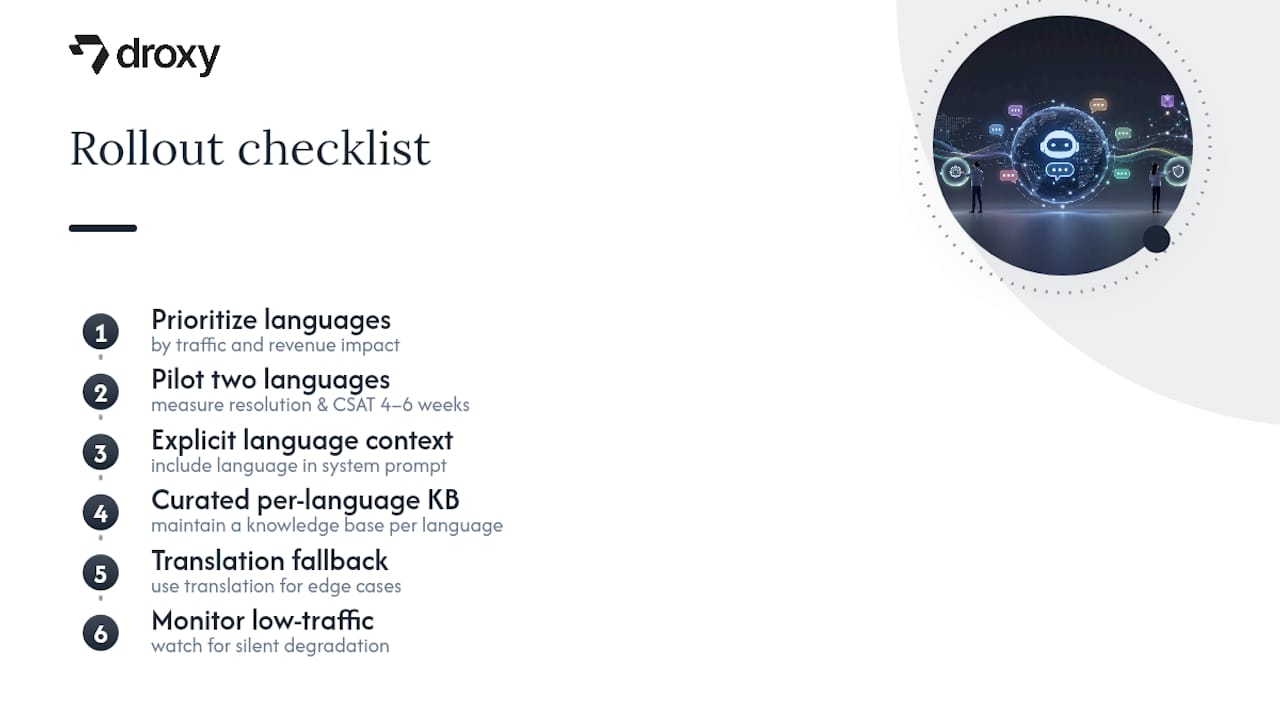
Prioritize languages by traffic and revenue impact, not by what feels comprehensive. Pilot with two languages, measure resolution and CSAT for four to six weeks, then expand using that data rather than guesswork.
Effective multilingual deployments favor explicit language context in the system prompt plus a curated knowledge base per language, layered with translation for edge cases. Watch for silent degradation in your lowest-traffic language. It’s the one nobody checks until a customer complains.
— Elena
Getting Multilingual Support Running Without a Dev Team
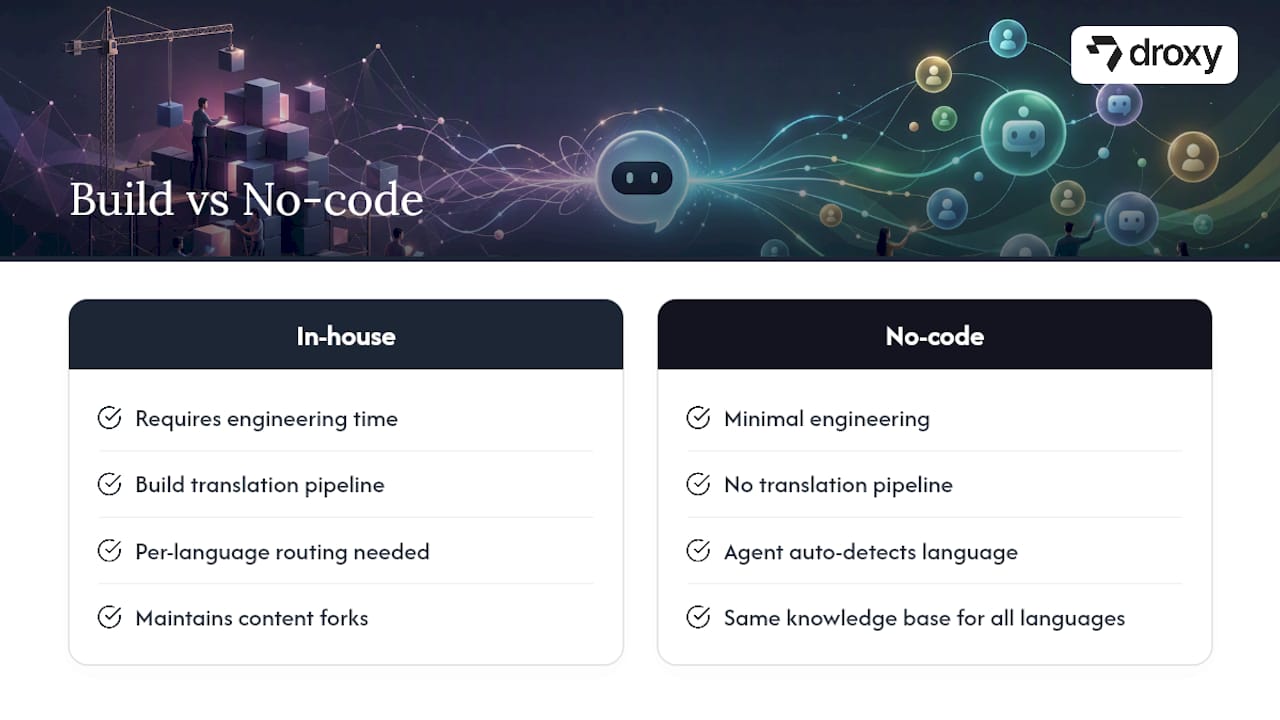
Most of what’s described above, explicit language prompting, hybrid localization, per-language routing, requires engineering time most teams don’t have to spare. Some platforms are built to skip the build phase entirely: you connect your knowledge sources, and the agent handles language detection, response generation, and human handoff across web chat, WhatsApp, Instagram, Facebook, and phone calls without writing a translation pipeline from scratch.
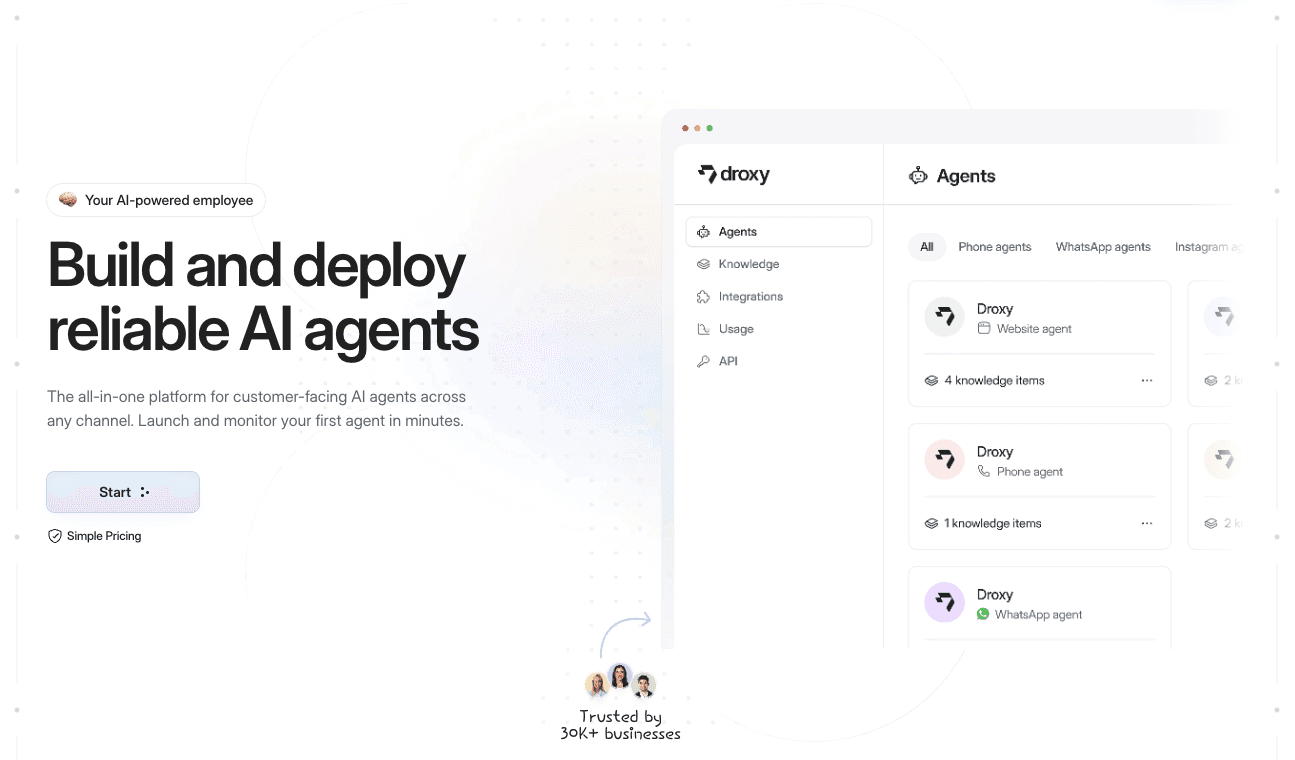
Where a translation-layer setup forces you to choose between fast-and-shallow or accurate-and-slow, Certain agents respond idiomatically in each customer’s language while pulling answers from the same knowledge base already maintained, without a separate content fork. Some providers offer white-label options so agencies managing multiple clients can resell under their own brand.
If you’re evaluating whether to build this in-house or adopt a no-code platform, compare Droxy’s pricing plans against your engineering timeline, or look at the phone agent capability if voice channels matter to your rollout. Booking a demo is the fastest way to see it running against your own content.
Sources
For architecture and evaluation methodology, read the peer-reviewed Multilingual Chatbot for Indian Languages paper. For prompt-level language handling, Claude’s multilingual support docs are the clearest reference available. For enterprise language-management configuration, check Kore.ai’s documentation, and for localization workflow, Crowdin’s multilingual chatbot guide covers staged rollout well. For system-prompt technique more broadly, this guide to humanizing AI text is worth a read, and Droxy’s own post on training a chatbot covers the fundamentals this article builds on.
FAQ
What Is a Multilingual Chatbot?
A multilingual chatbot is a conversational AI system that can detect, understand, and respond to users in more than one language, typically through either a translation layer, native per-language NLU models, or an LLM instructed with explicit language context.
Are AI Chatbots Legal to Use for Customer Support?
Yes, AI chatbots are legal for customer support in most jurisdictions worldwide, though data privacy rules like GDPR in the European Union require clear disclosure when a customer is interacting with an AI system and proper handling of any personal data collected.
What Are the Best AI Chatbots for Multiple Languages?
The strongest options depend on your use case: large language models like Claude offer broad native language coverage out of the box, enterprise platforms like Kore.ai give granular language-management controls, and no-code platforms like Droxy combine multilingual AI agents with omnichannel deployment across web, WhatsApp, and phone without requiring a development team.
How Do You Build a Multilingual Chatbot From Scratch?
Start by picking two or three high-traffic languages based on existing customer data, choose an architecture (translation layer or LLM-first for speed, native NLU for long-term fidelity), set explicit language context in your system prompt, build a curated knowledge base per language, and test with native speakers before expanding to more languages.
Recommended
A multilingual chatbot is a conversational system that detects, understands, and responds in more than one language, and the enterprise systems that hold up in production combine explicit language context in the prompt with a hybrid localization workflow. Platforms like Claude and Kore.ai both document this pattern, and some platforms build their own multilingual deployments with this approach.
TL;DR:
Most enterprises start with two or three high-demand languages and expand based on actual usage data to ensure meaningful coverage and avoid shallow support.
Using a translation layer or LLM-first architecture enables faster deployment, with native NLU reserved for high-volume languages to optimize cost and fidelity.
Reliable language detection relies on explicit user choice or session-locking, while guessing from short messages can lead to frequent errors and user frustration.
Combining machine translation for low-impact content and curated resource bundles for brand-sensitive material offers a balanced approach to localization costs and accuracy.
Regularly monitor intent accuracy, resolution rate, and user satisfaction in each language to detect issues early and maintain effective multilingual performance.
DroxyAnswer Customers Across More ChannelsDroxy helps businesses deploy customizable AI agents for instant customer interactions across website chat, phone, WhatsApp, Instagram, Facebook, and Shopify.Explore Droxy
Table of Contents
Why Multilingual Customer Support Pays Off
Which Chatbot Architecture Fits Multiple Languages?
How Should a Chatbot Detect and Lock In Language?
Should You Use Autotranslation or Curated Localization?
How Do You Train NLU Models for Multiple Languages?
What Metrics Prove a Multilingual Bot Is Working?
Where Should a Multilingual Chatbot Run?
A Rollout Checklist Worth Following
Getting Multilingual Support Running Without a Dev Team
Sources
Why Multilingual Customer Support Pays Off
Language coverage decides who your chatbot can actually help. A customer support bot that only speaks English is invisible to a large share of your visitor base, no matter how good its answers are for the people it can reach.
The business case comes down to three levers:
Reach: every added language opens a segment that was previously getting routed to a form, a voicemail, or nothing at all.
Conversion: shoppers and clients act faster when the interaction happens in their own language, especially at checkout or booking steps.
Agent load: a bot that resolves routine questions in Spanish, French, or Hindi keeps those tickets off your human queue entirely.
Start narrow. Most teams get more value launching with two or three high-traffic languages and expanding based on real usage data than trying to cover ten languages at launch with shallow support in each. Crowdin recommends localizing your most-read help articles and FAQs first, since that traffic tells you exactly where the demand already lives.
Which Chatbot Architecture Fits Multiple Languages?
Four architectural patterns dominate multilingual deployments, and each makes a different trade-off between cost, latency, and how well it preserves meaning across languages.
Rule-based, per-language: separate decision trees for each language. Cheap to run, predictable, but expensive to maintain and brittle outside scripted paths.
Translation layer: one core bot in a base language, with machine translation wrapped around input and output. Fast to launch, but idiom and tone often get lost in the round trip.
Native multilingual NLU: intent classifiers trained directly on data in each target language. Higher fidelity, but demands real per-language training data, which is expensive to collect for less common languages.
LLM-first: a large language model handles detection, understanding, and generation natively, guided by an explicit language instruction in the system prompt.
For most enterprise rollouts, the practical path is staged: launch on a translation layer or LLM-first pattern to move fast, then move your highest-volume languages to native NLU or curated prompt tuning once you have usage data to justify the investment. Kore.ai’s documentation shows how conversation language and NLU language can be configured separately, which is exactly the flexibility staged adoption needs.
How Should a Chatbot Detect and Lock In Language?
Guessing the user’s language from a single message is the single most common source of multilingual chatbot failures. Detection signals each carry their own risk:
Browser or device locale: reliable as a default, but wrong for travelers and multilingual households.
Explicit user choice: a language picker at session start, the most reliable signal available.
Utterance-based detection: works for longer messages, fails on short greetings like “hi” or “ok.”
IP-based geolocation: a weak fallback, useful only when nothing else is available.
Once a language is set, lock it for the session rather than re-detecting on every turn. Kore.ai’s guidance recommends persisting the chosen language and confirming with the user before switching mid-conversation if detection confidence drops, which avoids the jarring experience of a bot flipping languages mid-thread.
If you’re building on an LLM, don’t rely on the model to infer language correctly across turns. Claude’s own documentation is explicit on this point: interpolate the runtime language choice directly into the system prompt, and instruct the model to respond idiomatically as a native speaker rather than translating literally.
Pro Tip: Add a line like “Respond only in [detected language] using natural, idiomatic phrasing” to your system prompt. It sounds simple, but it’s the single biggest fix for language-mixing bugs in multi-turn conversations.
Should You Use Autotranslation or Curated Localization?
Machine translation and curated resource bundles solve different problems, and conflating them is where most localization budgets get wasted.
Autotranslation works well for long-tail, low-stakes content: order status updates, generic FAQ answers, casual conversation.
Resource bundles (pre-written, human-approved strings) belong on anything brand-facing or technical: pricing language, legal disclaimers, product names, error messages.
Fallback behavior matters too: if a translation isn’t available for a language, the bot should fall back to a clearly labeled default language rather than serving a broken string.
Industry guidance on specialized localization consistently favors a hybrid human-plus-MT approach for anything involving jargon or cultural nuance, since raw machine translation regularly mangles industry-specific terms. Oracle’s bot documentation shows one practical way to implement this: order translate and detect components ahead of resource bundles in your flow, so translation feeds intent resolution while the bundle controls exactly what the bot says back.
Pro Tip: Keep a single source-of-truth spreadsheet or localization management tool mapping every bundled string to its translations. When you update the English version, that file should flag every language that’s now out of sync.
How Do You Train NLU Models for Multiple Languages?
Two decisions shape everything else here: how you collect training data, and whether you run one shared multilingual model or separate models per language.
Data collection: map every intent across all target languages from day one, even if you launch with fewer languages, so your taxonomy doesn’t fracture later.
Model choice: a single multilingual model is easier to maintain and often performs competitively, though Claude’s own performance data shows real variation by language, meaning per-language testing before launch isn’t optional.
Low-resource languages: back-translation augmentation and synthetic data generated by bilingual speakers help fill gaps, an approach validated in peer-reviewed work on regional-language chatbots.
Code-switching: users mixing two languages in one message need intent labels that tolerate mixed input rather than forcing a single-language classification.
What Metrics Prove a Multilingual Bot Is Working?
Track quality per language, not as a single blended average. A bot performing well in English can mask a language that’s failing silently.
Intent accuracy by language, measured against a held-out native-speaker test set.
Resolution rate, the share of conversations closed without human handoff.
CSAT, collected in-language immediately after resolution.
Handoff rate, watched for spikes that flag a specific language struggling.
Testing needs layers too: native-speaker QA before launch, synthetic adversarial tests for edge cases, zero-shot checks on any language you haven’t explicitly trained for, and ongoing per-language A/B tests as you tune prompts. The IEEE research on regional-language chatbots stresses maintaining a native-speaker validation pool for every language before launch, not just at initial build. Set an automated alert threshold, so a sudden drop in resolution rate for one language triggers review within hours, not at the next quarterly report.
Where Should a Multilingual Chatbot Run?
Deployment channel matters as much as language coverage. A bot fluent in six languages is only useful where your customers actually show up.
Web chat, WhatsApp, Instagram, and phone agents each need their own language-detection entry point, since a WhatsApp number tied to a specific country carries a strong locale signal a website visitor doesn’t.
CRM and knowledge-base integration should support multilingual retrieval, meaning your vector search needs to handle queries and source documents in different languages without losing relevance.
Human handoff rules should route by detected language to an agent who speaks it, with SLA timers that account for fewer available agents in lower-resource languages.
For a deeper look at the feature set enterprise deployments typically need across these channels, see this breakdown of enterprise chatbot solution features.
A Rollout Checklist Worth Following
Prioritize languages by traffic and revenue impact, not by what feels comprehensive. Pilot with two languages, measure resolution and CSAT for four to six weeks, then expand using that data rather than guesswork.
Effective multilingual deployments favor explicit language context in the system prompt plus a curated knowledge base per language, layered with translation for edge cases. Watch for silent degradation in your lowest-traffic language. It’s the one nobody checks until a customer complains.
— Elena
Getting Multilingual Support Running Without a Dev Team
Most of what’s described above, explicit language prompting, hybrid localization, per-language routing, requires engineering time most teams don’t have to spare. Some platforms are built to skip the build phase entirely: you connect your knowledge sources, and the agent handles language detection, response generation, and human handoff across web chat, WhatsApp, Instagram, Facebook, and phone calls without writing a translation pipeline from scratch.
Where a translation-layer setup forces you to choose between fast-and-shallow or accurate-and-slow, Certain agents respond idiomatically in each customer’s language while pulling answers from the same knowledge base already maintained, without a separate content fork. Some providers offer white-label options so agencies managing multiple clients can resell under their own brand.
If you’re evaluating whether to build this in-house or adopt a no-code platform, compare Droxy’s pricing plans against your engineering timeline, or look at the phone agent capability if voice channels matter to your rollout. Booking a demo is the fastest way to see it running against your own content.
Sources
For architecture and evaluation methodology, read the peer-reviewed Multilingual Chatbot for Indian Languages paper. For prompt-level language handling, Claude’s multilingual support docs are the clearest reference available. For enterprise language-management configuration, check Kore.ai’s documentation, and for localization workflow, Crowdin’s multilingual chatbot guide covers staged rollout well. For system-prompt technique more broadly, this guide to humanizing AI text is worth a read, and Droxy’s own post on training a chatbot covers the fundamentals this article builds on.
FAQ
What Is a Multilingual Chatbot?
A multilingual chatbot is a conversational AI system that can detect, understand, and respond to users in more than one language, typically through either a translation layer, native per-language NLU models, or an LLM instructed with explicit language context.
Are AI Chatbots Legal to Use for Customer Support?
Yes, AI chatbots are legal for customer support in most jurisdictions worldwide, though data privacy rules like GDPR in the European Union require clear disclosure when a customer is interacting with an AI system and proper handling of any personal data collected.
What Are the Best AI Chatbots for Multiple Languages?
The strongest options depend on your use case: large language models like Claude offer broad native language coverage out of the box, enterprise platforms like Kore.ai give granular language-management controls, and no-code platforms like Droxy combine multilingual AI agents with omnichannel deployment across web, WhatsApp, and phone without requiring a development team.
How Do You Build a Multilingual Chatbot From Scratch?
Start by picking two or three high-traffic languages based on existing customer data, choose an architecture (translation layer or LLM-first for speed, native NLU for long-term fidelity), set explicit language context in your system prompt, build a curated knowledge base per language, and test with native speakers before expanding to more languages.
Recommended


🚀
Powered by Droxy
Turn every interaction into a conversion
Customer facing AI agents that engage, convert, and support so you can scale what matters.
✨
Learn more
Recent posts
Insights
3 min read
Introducing Agent Memories
Improve your agents' performance with Agent Memories. Prevent agents from repeating the same mistakes by giving them feedback.
Read more

Insights
15 min read
HVAC Marketing in 2025: The Definitive Lead Gen Guide
Discover 15 proven HVAC marketing strategies, plus learn how Droxy's AI website agent converts curious visitors into qualified leads by answering their questions instantly - right when they're most interested in your services.
Read more
Insights
10 min read
10 Best AI Sales Agents in 2025: Tested & Ranked
Discover the top 10 AI sales agents of 2025, designed to enhance lead generation, personalize outreach, and ultimately, close more deals
Read more
Insights
3 min read
Introducing Agent Memories
Improve your agents' performance with Agent Memories. Prevent agents from repeating the same mistakes by giving them feedback.
Read more
Insights
15 min read
HVAC Marketing in 2025: The Definitive Lead Gen Guide
Discover 15 proven HVAC marketing strategies, plus learn how Droxy's AI website agent converts curious visitors into qualified leads by answering their questions instantly - right when they're most interested in your services.
Read more