30 Day Test to Turn Instagram Views into WhatsApp Sales for Businesses
30 Day Test to Turn Instagram Views into WhatsApp Sales for Businesses
Insights
22 min
For private, reliable conversations, choose WhatsApp. For discovery, visual storytelling, and audience growth, choose Instagram. Businesses rarely need to pick just one: a common pattern uses Instagram to attract attention and WhatsApp to close the sale or handle support. Both platforms now offer serious business tools, from WhatsApp Business and the WhatsApp Business API to Instagram professional accounts, Shops, and ads.
TL;DR:
WhatsApp is the preferred platform for private, high-trust communication with features like end-to-end encryption, voice notes, and stable calls, especially for supporting existing customer relationships.
Instagram excels in audience discovery, visual storytelling, and organic reach, making it ideal for brand building, content distribution, and attracting new followers.
Most businesses combine both platforms, using Instagram to generate attention and WhatsApp to convert leads, support support, and close sales through integrated workflows.
Automation tools like no-code AI agents support both apps, allowing businesses to handle inquiries and leads efficiently without large teams.
Privacy practices differ, with WhatsApp prioritizing message content confidentiality through encryption, while Instagram collects behavioral data for targeted advertising and recommendations.
DroxyTurn Social Attention Into ConversationsDroxy deploys customizable AI agents across WhatsApp and Instagram, helping businesses answer inquiries instantly and support leads around the clock.Explore Droxy
Table of Contents
Instagram vs WhatsApp at a Glance
How Do Messaging and Media Features Compare?
Which App Protects Your Privacy Better?
What Business Tools Does Each Platform Offer?
How Do Automation and Integrations Work Across Both Apps?
What’s the Fastest Way to Choose or Combine Both Platforms?
How Do Instagram and WhatsApp Handle Your Data Behind the Scenes?
Can Instagram and WhatsApp Work Together?
What New Features Are Coming to Instagram and WhatsApp?
The Real Tradeoff Nobody Talks About
Automate Both Channels Without Hiring a Bigger Team
Sources
Instagram vs WhatsApp at a Glance
You don’t need to read a dozen tabs of feature comparisons to make a smart call here. The two platforms solve different problems, and once you see them side by side, the decision usually makes itself.
Best for: WhatsApp wins for one-to-one and group conversations; Instagram wins for reach, discovery, and brand storytelling.
Messaging features: WhatsApp offers deeper group tools, voice notes, and stable calling; Instagram DMs are tied to your public profile and feed activity.
Privacy level: WhatsApp defaults to end-to-end encryption; Instagram blends public discovery with private messaging and leans more on behavioral data.
Marketing strength: Instagram dominates for organic reach, Reels, and creator partnerships; WhatsApp shines for direct, high-intent conversations with warm leads.
Integrations: Both support APIs and third-party automation, but WhatsApp’s Business API is built specifically for structured, scaled messaging.
Cost hints: Instagram’s core tools are free with paid ad options; WhatsApp is free for the Business app, with usage-based pricing once you scale into the API.
If you’re a solo user who wants to text friends and family, WhatsApp is the obvious pick. If you’re a small business trying to build an audience from zero, Instagram usually gets you there faster. If you run an ecommerce store, you’ll likely want Instagram for discovery and WhatsApp (or its Business API) for order updates and support. If you’re a creator, Instagram is close to non-negotiable for growth, with WhatsApp as your back channel for serious fans and brand deals.
The smartest businesses don’t treat this as an either/or question. They post and advertise on Instagram, then move warm conversations into WhatsApp, where replies feel more personal and less likely to get lost in a feed algorithm.
How Do Messaging and Media Features Compare?
The core experience of “talking to someone” is genuinely different on these two apps, and that difference matters more than most comparisons admit.
WhatsApp is built around your phone number. That single design choice shapes everything else: group chats are easier to manage at scale, voice notes are a first-class feature rather than an afterthought, and one-on-one or group calling tends to feel more stable, especially across countries with patchy data connections. A desktop client rounds it out, which matters if your team is coordinating logistics, customer support, or a supply chain conversation that needs to happen at a keyboard, not a thumb.
Instagram’s messaging lives inside a completely different context. Direct messages are tied to your public profile, and conversations often start because someone saw a post, a Story, or a Reel and wanted to react. That makes Instagram DMs feel more like an extension of content than a standalone inbox. It’s excellent for a quick reply to a comment or a fan sending a screenshot of your product, less so for anyone trying to search back through six months of order history.
Where each app pulls ahead:
WhatsApp: group management, voice notes, calling reliability, desktop access, cross-country reach without carrier fees.
Instagram: seamless sharing of visual posts, native Stories and Reels replies, creator-to-fan interaction, discovery-driven conversation starters.
Media handling is its own story. WhatsApp compresses images and video fairly aggressively to keep things fast on weaker connections, and now offers disappearing media for one-time views. Instagram is built for presentation first: feed posts, Stories, and Reels are meant to look good, which is exactly why product photography and demo videos tend to land better there than in a chat thread.
Think about three real scenarios. A customer sends photos of a damaged product: WhatsApp’s stable media delivery and searchable chat history make it the better support channel. A creator wants to share a new Reel with an engaged following: Instagram is simply the only place that makes sense. A team of five is coordinating a multi-city event: WhatsApp’s group tools and desktop app hold up better than trying to run logistics through Instagram DMs.
Pro Tip: If your business gets a lot of visual complaints (damaged goods, wrong sizes, before-and-after requests), push those conversations from Instagram DMs into WhatsApp. The image quality and message search will save you real time.
Which App Protects Your Privacy Better?
WhatsApp defaults to end-to-end encryption for messages, while Instagram mixes public discovery with private messaging and collects more behavioral data to power its recommendations, according to a comparative breakdown of major messaging apps. That single distinction is the real story behind “which app is better” for anyone worried about who can see their conversations.
Encryption on WhatsApp means the content of your messages, calls, and shared media is scrambled end to end. Nobody in the middle, including the platform, can read the text of a normal chat. That said, encryption doesn’t mean invisibility. WhatsApp still collects metadata: who you’re talking to, how often, your profile photo, your status, and device information. If you back up chats to cloud storage without extra encryption enabled, those backups can be more exposed than the messages themselves.
Instagram works from a different starting design. It’s fundamentally a public platform with private messaging bolted on. Direct messages aren’t end-to-end encrypted by default the same way WhatsApp’s are, and the platform actively tracks engagement, browsing behavior, and ad interactions to build a profile it uses for recommendations and targeting. That’s the tradeoff for a feed that gets better at showing you things you’ll actually want to see.
Settings worth adjusting on each platform:
WhatsApp: turn on encrypted chat backups, review who can see your “last seen” and profile photo, and use disappearing messages for sensitive threads.
Instagram: switch to a private account if you’re not actively marketing, limit who can message you outside your followers, and review third-party app access regularly.
Both: audit connected devices and log out of sessions you don’t recognize.
For businesses handling customer data, whether that’s order details, health information, or payment confirmations, the practical rule is simple: keep sensitive exchanges on the platform with encryption by default, and treat public-facing DMs as semi-public no matter what the interface implies. If your business touches regulated data, checking each platform’s official documentation or talking to legal counsel beats guessing based on a blog post.
What Business Tools Does Each Platform Offer?
Both platforms have matured into real commerce engines, but they solve different parts of the sales funnel.
WhatsApp Business and the WhatsApp Business API. Small teams can run the free WhatsApp Business app for basic automation like greeting messages and quick replies. Larger operations move to the API, which supports message templates, automated notifications, and structured customer service flows, though templates require approval before they can be sent at scale.
Instagram professional and creator accounts. These unlock analytics, ad tools, and Shops functionality, letting businesses tag products directly in posts and Reels so a viewer can go from “interesting photo” to “checkout” without leaving the app.
Conversational commerce on WhatsApp. Catalogs and cart features let customers browse and buy without ever opening a website, which matters most in markets where WhatsApp is already the default communication layer.
Discovery-driven commerce on Instagram. Reels and organic reach still function as a genuine growth engine for brands willing to invest in content, especially since Instagram remains one of the strongest platforms for creator-led discovery and visual commerce.
Younger shoppers in particular have shifted toward social-driven buying, a pattern that accelerated during pandemic lockdowns and hasn’t fully reversed, based on survey data on teen online shopping behavior. That trend favors Instagram for the top of the funnel and WhatsApp for the close.
Cost varies enough by region and use case that guessing is a bad idea. Instagram’s advertising costs depend on auction dynamics tied to your audience and objective, and WhatsApp’s Business API pricing depends on conversation volume and country. Check each platform’s official business documentation directly before budgeting.
Pro Tip: Pair one strong Instagram content strategy with proven social proof tactics like reviews and testimonials in your Stories. Warm leads convert far better once they see other real customers vouching for you.
How Do Automation and Integrations Work Across Both Apps?
If you’re running a business, the real question isn’t which app has better native features. It’s how well each one plugs into the tools you already use to run customer support, sales, and logistics.
Common integration goals look almost identical across both platforms: capturing leads automatically, sending order status updates, routing support tickets, and feeding conversation data into analytics dashboards. Where the platforms differ is access. WhatsApp’s Business API requires approval and typically takes days to weeks to set up depending on your provider, while Instagram’s messaging API access is tied to your connected Facebook Business account and ad permissions.
Automation patterns that actually hold up in production:
Pre-approved message templates for order confirmations and shipping updates.
Chatbot flows that answer FAQs instantly, then hand off to a human the moment a question gets complex.
Escalation rules that flag frustrated customers based on keywords or repeated messages.
Analytics tracking response time, resolution rate, and conversion from chat to sale.
This is exactly where a no-code platform earns its keep. Droxy lets businesses deploy AI agents across both the WhatsApp and Instagram channels, answering common questions instantly, capturing leads while a team is offline, and handing off to a real person the moment a conversation needs a human touch. Instead of building custom integrations from scratch, businesses connect existing systems and get automated responses running across both platforms without writing code.
What’s the Fastest Way to Choose or Combine Both Platforms?
Start with your primary goal, not your personal preference. If you need reliable, private, one-to-one communication with customers or teammates, default to WhatsApp. If your goal is building an audience from zero or showcasing products visually, default to Instagram. If you’re doing both (which most growing businesses eventually do), use Instagram to generate attention and WhatsApp to convert it into a real relationship.
Run through this quick checklist before committing to either platform, or both:
Reader profile | Recommended first step |
|---|---|
Personal user | Start with WhatsApp for private chats; keep Instagram for casual browsing and following friends. |
Small ecommerce business | Set up Instagram Shops for discovery, WhatsApp Business for order support and follow-up. |
Service business (local, appointment-based) | Use WhatsApp Business for booking confirmations and reminders; use Instagram for local visibility and reviews. |
Creator or influencer | Prioritize Instagram for growth and brand deals; use WhatsApp for direct fan and sponsor communication. |
Before you scale anything, confirm four things: your audience actually spends time where you’re investing (check age and region data, since Instagram’s user base skews toward the 18 to 34 age group), your required features exist on that platform, you have a plan for automation once volume grows, and you have basic measurement in place, response time, conversion rate, and customer satisfaction, before you spend a dollar on ads.
How Do Instagram and WhatsApp Handle Your Data Behind the Scenes?
Privacy settings control who can see your messages. Data policy controls what each company does with information about you long after a conversation ends, and that’s a separate question worth understanding.
WhatsApp, owned by Meta, retains limited message content thanks to encryption, but it still stores account metadata, contact information, and usage patterns, and it shares certain data with other Meta platforms for security and integration purposes. Because WhatsApp functions as the default messaging utility in many countries, its data practices affect an enormous slice of daily global communication, not a niche audience.
Instagram takes a more expansive approach by design. Every like, save, watch time, and scroll pattern feeds an algorithm built to predict what keeps you engaged. That data doesn’t just power your feed. It powers ad targeting, which is Instagram’s core revenue engine. Storage retention for this behavioral data tends to be longer and more granular than WhatsApp’s message metadata, simply because the business model depends on it.
For businesses, the practical implication is this: any customer data you collect through either platform’s business tools is still subject to Meta’s broader data policies, not just the platform-specific terms you might assume apply. Before storing customer conversations, phone numbers, or purchase history pulled from either app, check the current business data terms on each platform’s official developer documentation. Policies get updated more often than most companies realize, and assumptions based on last year’s terms can create compliance gaps.
Can Instagram and WhatsApp Work Together?
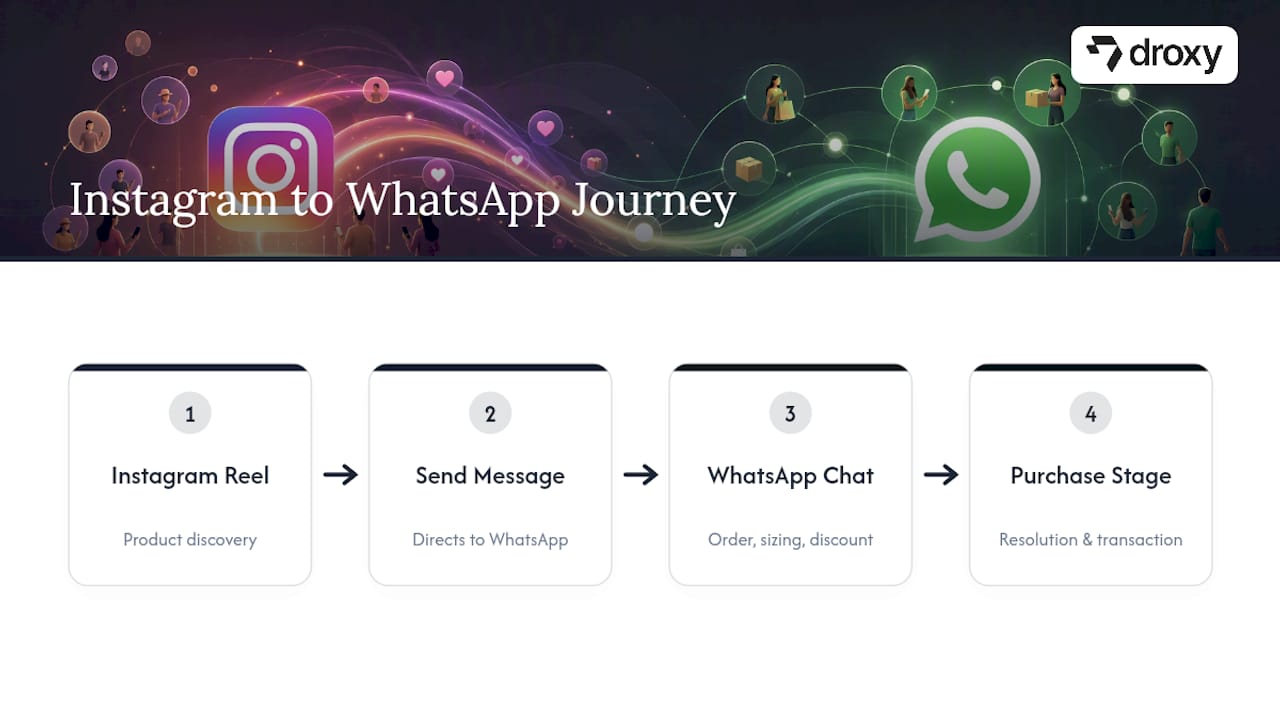
Yes, and Meta has built real bridges between them, not just shared ownership on paper. A business running ads on Instagram can direct a “Send Message” button straight into a WhatsApp conversation, skipping the DM inbox entirely and landing the customer in a channel built for longer, more transactional exchanges.
This matters most at the handoff point between marketing and sales. Someone scrolling Instagram sees a product Reel, taps through, and instead of getting lost in a comment thread, ends up in a WhatsApp chat with order details, sizing questions, or a discount code waiting for them. That’s a meaningfully shorter path from interest to purchase than trying to manage the entire relationship inside Instagram DMs alone.
The two platforms also share underlying infrastructure through Meta’s Business Suite, which means ad performance data, contact information, and some automation rules can sync across both without duplicate setup. A message template built for WhatsApp doesn’t automatically work on Instagram (the platforms still have separate messaging APIs), but the business account structure connecting them makes managing both from one dashboard realistic rather than aspirational.
The practical takeaway: don’t think of Instagram and WhatsApp as competing for your attention. Think of them as two stages of the same conversation, discovery on one, resolution on the other, connected by Meta’s shared business tools rather than left as isolated apps.
What New Features Are Coming to Instagram and WhatsApp?
The two platforms are pulling in noticeably different directions heading into 2026. Industry tracking shows WhatsApp doubling down on private utility and AI-assisted help within conversations, while Instagram keeps investing in discovery and tools built specifically for creators.
On WhatsApp’s side, that means smarter in-chat assistance: features designed to help you draft replies, summarize long group threads, and get quick answers without leaving the conversation. It’s a natural extension of what WhatsApp already does well: keeping communication private and efficient rather than turning the app into a content feed.
Instagram’s roadmap leans further into features built around growth and repost culture, tools that make it easier for content to travel and for creators to build sustained audiences rather than one-off viral moments. That’s consistent with Instagram’s broader identity: a discovery engine first, a messaging app second.
For businesses, the pattern is worth planning around rather than reacting to later. WhatsApp is becoming a better private support and sales channel; Instagram is becoming a better discovery and content channel. Betting on both, with clear roles for each, positions you better than betting your entire strategy on whichever platform trends this quarter.
The Real Tradeoff Nobody Talks About
Most comparisons treat this as a popularity contest. It isn’t. The honest tradeoff is between control and reach. WhatsApp gives you a controlled, private, high-trust channel where every message feels intentional. Instagram gives you reach and discovery, but at the cost of noise: your message competes with an algorithm, a feed, and everyone else’s content.
Businesses that win usually stop asking “which platform is better” and start asking “what job does each one do for me.” Measure response time and conversion on both channels for thirty days before scaling either one. Test a two-channel workflow, Instagram for attention, WhatsApp for follow-through, before committing your whole marketing budget to just one.
— Elena
Automate Both Channels Without Hiring a Bigger Team
Droxy gives you one place to run AI agents across both platforms you just compared, so leads generated on Instagram don’t sit unanswered while you’re offline, and WhatsApp conversations don’t require a dedicated staffer watching a phone all day.
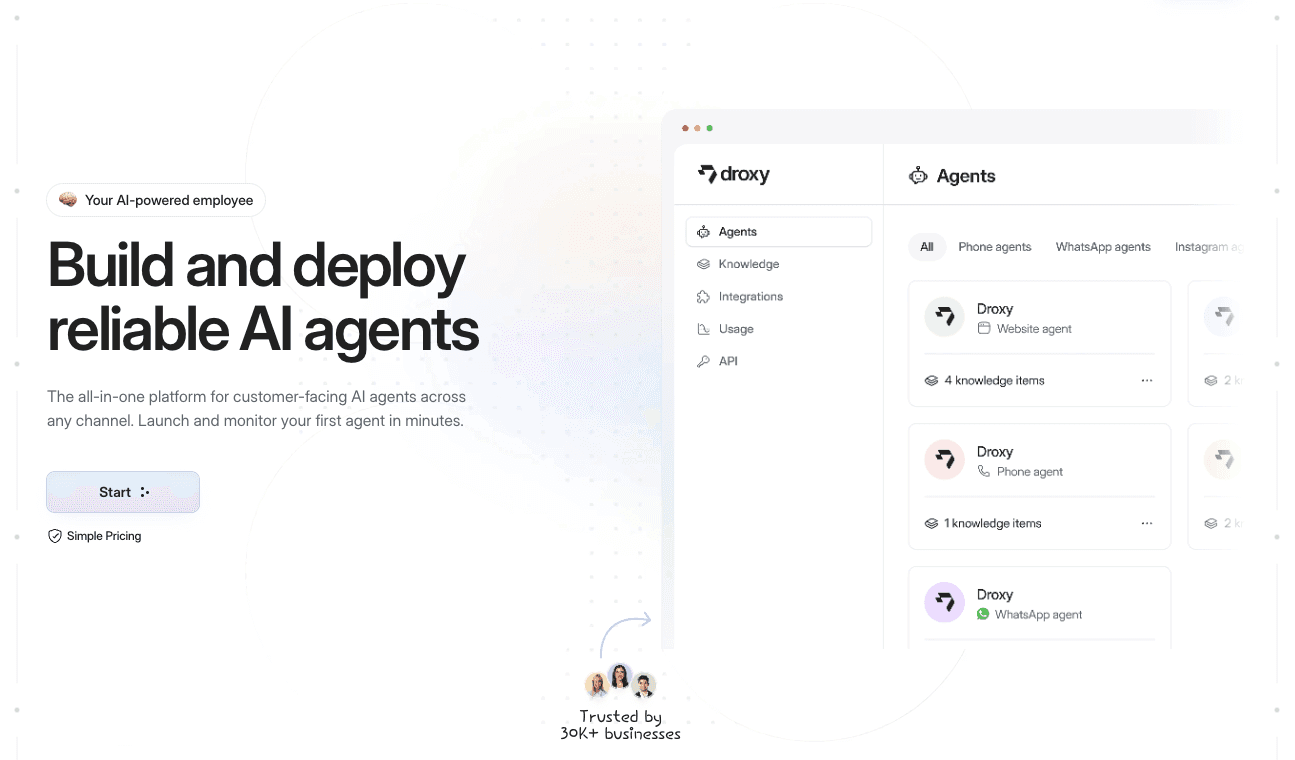
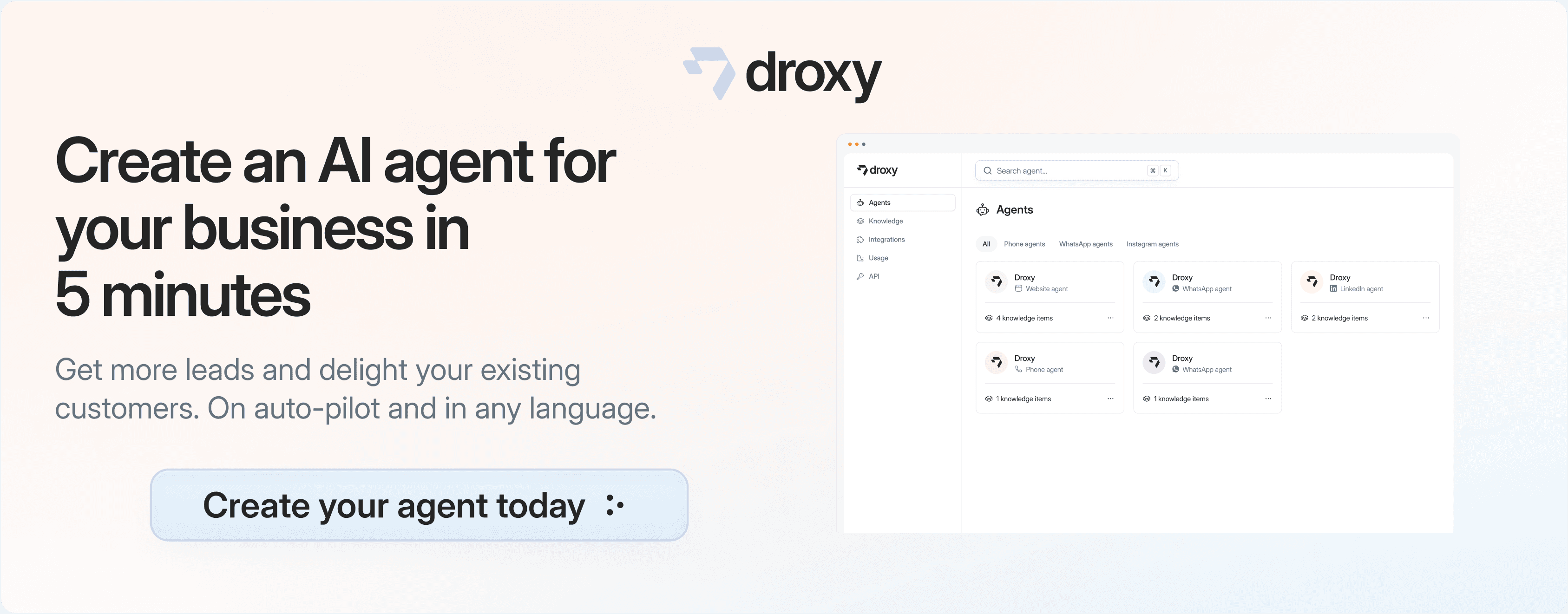
The platform deploys no-code AI agents that answer questions instantly, capture leads, and hand off to a human teammate the moment a conversation needs one, all without writing a line of code. A typical flow looks like this: a customer discovers your product through an Instagram Reel, messages your account, gets an instant answer from your Instagram agent, and if the conversation needs more detail or a purchase decision, gets moved into a WhatsApp agent that handles order questions, appointment booking, or support around the clock. Agencies managing this for multiple clients can white-label the entire experience under their own brand. Everything connects to your existing systems, and pricing scales with your business rather than locking you into a flat rate you might outgrow. Check Droxy’s pricing and start a trial to see how quickly both channels start converting on their own.
Sources
Instagram: distribution of users worldwide by age group — Statista
WhatsApp vs Instagram vs Facebook — new features compared 2026 — TryFormatter
WhatsApp vs Instagram vs Facebook Messenger vs Snapchat — TechBloat
FAQ
What Is Better, Instagram or WhatsApp?
Neither is universally better; WhatsApp wins for private, reliable messaging, and Instagram wins for discovery and audience growth, which is why most businesses use both.
Why Don’t Americans Use WhatsApp as Much?
WhatsApp adoption depends heavily on regional habit and default carrier behavior; in markets like the United States, other messaging apps became the default early, while WhatsApp remains dominant across much of the MENA region and beyond partly due to established convenience and habit patterns.
Is Instagram Safer Than WhatsApp?
No, WhatsApp is generally considered more private for message content because it defaults to end-to-end encryption, while Instagram collects more behavioral data to power ad targeting and recommendations.
Why Are People Moving Away From WhatsApp?
Most shifts in messaging app preference come down to regional trends and changing default apps rather than a mass exodus; WhatsApp still functions as the default messaging layer in many countries worldwide.
Can a Business Automate Both Instagram and WhatsApp at Once?
Yes, platforms like Droxy let businesses deploy no-code AI agents across both channels simultaneously, so leads and support questions get instant responses on whichever app the customer prefers.
Recommended
For private, reliable conversations, choose WhatsApp. For discovery, visual storytelling, and audience growth, choose Instagram. Businesses rarely need to pick just one: a common pattern uses Instagram to attract attention and WhatsApp to close the sale or handle support. Both platforms now offer serious business tools, from WhatsApp Business and the WhatsApp Business API to Instagram professional accounts, Shops, and ads.
TL;DR:
WhatsApp is the preferred platform for private, high-trust communication with features like end-to-end encryption, voice notes, and stable calls, especially for supporting existing customer relationships.
Instagram excels in audience discovery, visual storytelling, and organic reach, making it ideal for brand building, content distribution, and attracting new followers.
Most businesses combine both platforms, using Instagram to generate attention and WhatsApp to convert leads, support support, and close sales through integrated workflows.
Automation tools like no-code AI agents support both apps, allowing businesses to handle inquiries and leads efficiently without large teams.
Privacy practices differ, with WhatsApp prioritizing message content confidentiality through encryption, while Instagram collects behavioral data for targeted advertising and recommendations.
DroxyTurn Social Attention Into ConversationsDroxy deploys customizable AI agents across WhatsApp and Instagram, helping businesses answer inquiries instantly and support leads around the clock.Explore Droxy
Table of Contents
Instagram vs WhatsApp at a Glance
How Do Messaging and Media Features Compare?
Which App Protects Your Privacy Better?
What Business Tools Does Each Platform Offer?
How Do Automation and Integrations Work Across Both Apps?
What’s the Fastest Way to Choose or Combine Both Platforms?
How Do Instagram and WhatsApp Handle Your Data Behind the Scenes?
Can Instagram and WhatsApp Work Together?
What New Features Are Coming to Instagram and WhatsApp?
The Real Tradeoff Nobody Talks About
Automate Both Channels Without Hiring a Bigger Team
Sources
Instagram vs WhatsApp at a Glance
You don’t need to read a dozen tabs of feature comparisons to make a smart call here. The two platforms solve different problems, and once you see them side by side, the decision usually makes itself.
Best for: WhatsApp wins for one-to-one and group conversations; Instagram wins for reach, discovery, and brand storytelling.
Messaging features: WhatsApp offers deeper group tools, voice notes, and stable calling; Instagram DMs are tied to your public profile and feed activity.
Privacy level: WhatsApp defaults to end-to-end encryption; Instagram blends public discovery with private messaging and leans more on behavioral data.
Marketing strength: Instagram dominates for organic reach, Reels, and creator partnerships; WhatsApp shines for direct, high-intent conversations with warm leads.
Integrations: Both support APIs and third-party automation, but WhatsApp’s Business API is built specifically for structured, scaled messaging.
Cost hints: Instagram’s core tools are free with paid ad options; WhatsApp is free for the Business app, with usage-based pricing once you scale into the API.
If you’re a solo user who wants to text friends and family, WhatsApp is the obvious pick. If you’re a small business trying to build an audience from zero, Instagram usually gets you there faster. If you run an ecommerce store, you’ll likely want Instagram for discovery and WhatsApp (or its Business API) for order updates and support. If you’re a creator, Instagram is close to non-negotiable for growth, with WhatsApp as your back channel for serious fans and brand deals.
The smartest businesses don’t treat this as an either/or question. They post and advertise on Instagram, then move warm conversations into WhatsApp, where replies feel more personal and less likely to get lost in a feed algorithm.
How Do Messaging and Media Features Compare?
The core experience of “talking to someone” is genuinely different on these two apps, and that difference matters more than most comparisons admit.
WhatsApp is built around your phone number. That single design choice shapes everything else: group chats are easier to manage at scale, voice notes are a first-class feature rather than an afterthought, and one-on-one or group calling tends to feel more stable, especially across countries with patchy data connections. A desktop client rounds it out, which matters if your team is coordinating logistics, customer support, or a supply chain conversation that needs to happen at a keyboard, not a thumb.
Instagram’s messaging lives inside a completely different context. Direct messages are tied to your public profile, and conversations often start because someone saw a post, a Story, or a Reel and wanted to react. That makes Instagram DMs feel more like an extension of content than a standalone inbox. It’s excellent for a quick reply to a comment or a fan sending a screenshot of your product, less so for anyone trying to search back through six months of order history.
Where each app pulls ahead:
WhatsApp: group management, voice notes, calling reliability, desktop access, cross-country reach without carrier fees.
Instagram: seamless sharing of visual posts, native Stories and Reels replies, creator-to-fan interaction, discovery-driven conversation starters.
Media handling is its own story. WhatsApp compresses images and video fairly aggressively to keep things fast on weaker connections, and now offers disappearing media for one-time views. Instagram is built for presentation first: feed posts, Stories, and Reels are meant to look good, which is exactly why product photography and demo videos tend to land better there than in a chat thread.
Think about three real scenarios. A customer sends photos of a damaged product: WhatsApp’s stable media delivery and searchable chat history make it the better support channel. A creator wants to share a new Reel with an engaged following: Instagram is simply the only place that makes sense. A team of five is coordinating a multi-city event: WhatsApp’s group tools and desktop app hold up better than trying to run logistics through Instagram DMs.
Pro Tip: If your business gets a lot of visual complaints (damaged goods, wrong sizes, before-and-after requests), push those conversations from Instagram DMs into WhatsApp. The image quality and message search will save you real time.
Which App Protects Your Privacy Better?
WhatsApp defaults to end-to-end encryption for messages, while Instagram mixes public discovery with private messaging and collects more behavioral data to power its recommendations, according to a comparative breakdown of major messaging apps. That single distinction is the real story behind “which app is better” for anyone worried about who can see their conversations.
Encryption on WhatsApp means the content of your messages, calls, and shared media is scrambled end to end. Nobody in the middle, including the platform, can read the text of a normal chat. That said, encryption doesn’t mean invisibility. WhatsApp still collects metadata: who you’re talking to, how often, your profile photo, your status, and device information. If you back up chats to cloud storage without extra encryption enabled, those backups can be more exposed than the messages themselves.
Instagram works from a different starting design. It’s fundamentally a public platform with private messaging bolted on. Direct messages aren’t end-to-end encrypted by default the same way WhatsApp’s are, and the platform actively tracks engagement, browsing behavior, and ad interactions to build a profile it uses for recommendations and targeting. That’s the tradeoff for a feed that gets better at showing you things you’ll actually want to see.
Settings worth adjusting on each platform:
WhatsApp: turn on encrypted chat backups, review who can see your “last seen” and profile photo, and use disappearing messages for sensitive threads.
Instagram: switch to a private account if you’re not actively marketing, limit who can message you outside your followers, and review third-party app access regularly.
Both: audit connected devices and log out of sessions you don’t recognize.
For businesses handling customer data, whether that’s order details, health information, or payment confirmations, the practical rule is simple: keep sensitive exchanges on the platform with encryption by default, and treat public-facing DMs as semi-public no matter what the interface implies. If your business touches regulated data, checking each platform’s official documentation or talking to legal counsel beats guessing based on a blog post.
What Business Tools Does Each Platform Offer?
Both platforms have matured into real commerce engines, but they solve different parts of the sales funnel.
WhatsApp Business and the WhatsApp Business API. Small teams can run the free WhatsApp Business app for basic automation like greeting messages and quick replies. Larger operations move to the API, which supports message templates, automated notifications, and structured customer service flows, though templates require approval before they can be sent at scale.
Instagram professional and creator accounts. These unlock analytics, ad tools, and Shops functionality, letting businesses tag products directly in posts and Reels so a viewer can go from “interesting photo” to “checkout” without leaving the app.
Conversational commerce on WhatsApp. Catalogs and cart features let customers browse and buy without ever opening a website, which matters most in markets where WhatsApp is already the default communication layer.
Discovery-driven commerce on Instagram. Reels and organic reach still function as a genuine growth engine for brands willing to invest in content, especially since Instagram remains one of the strongest platforms for creator-led discovery and visual commerce.
Younger shoppers in particular have shifted toward social-driven buying, a pattern that accelerated during pandemic lockdowns and hasn’t fully reversed, based on survey data on teen online shopping behavior. That trend favors Instagram for the top of the funnel and WhatsApp for the close.
Cost varies enough by region and use case that guessing is a bad idea. Instagram’s advertising costs depend on auction dynamics tied to your audience and objective, and WhatsApp’s Business API pricing depends on conversation volume and country. Check each platform’s official business documentation directly before budgeting.
Pro Tip: Pair one strong Instagram content strategy with proven social proof tactics like reviews and testimonials in your Stories. Warm leads convert far better once they see other real customers vouching for you.
How Do Automation and Integrations Work Across Both Apps?
If you’re running a business, the real question isn’t which app has better native features. It’s how well each one plugs into the tools you already use to run customer support, sales, and logistics.
Common integration goals look almost identical across both platforms: capturing leads automatically, sending order status updates, routing support tickets, and feeding conversation data into analytics dashboards. Where the platforms differ is access. WhatsApp’s Business API requires approval and typically takes days to weeks to set up depending on your provider, while Instagram’s messaging API access is tied to your connected Facebook Business account and ad permissions.
Automation patterns that actually hold up in production:
Pre-approved message templates for order confirmations and shipping updates.
Chatbot flows that answer FAQs instantly, then hand off to a human the moment a question gets complex.
Escalation rules that flag frustrated customers based on keywords or repeated messages.
Analytics tracking response time, resolution rate, and conversion from chat to sale.
This is exactly where a no-code platform earns its keep. Droxy lets businesses deploy AI agents across both the WhatsApp and Instagram channels, answering common questions instantly, capturing leads while a team is offline, and handing off to a real person the moment a conversation needs a human touch. Instead of building custom integrations from scratch, businesses connect existing systems and get automated responses running across both platforms without writing code.
What’s the Fastest Way to Choose or Combine Both Platforms?
Start with your primary goal, not your personal preference. If you need reliable, private, one-to-one communication with customers or teammates, default to WhatsApp. If your goal is building an audience from zero or showcasing products visually, default to Instagram. If you’re doing both (which most growing businesses eventually do), use Instagram to generate attention and WhatsApp to convert it into a real relationship.
Run through this quick checklist before committing to either platform, or both:
Reader profile | Recommended first step |
|---|---|
Personal user | Start with WhatsApp for private chats; keep Instagram for casual browsing and following friends. |
Small ecommerce business | Set up Instagram Shops for discovery, WhatsApp Business for order support and follow-up. |
Service business (local, appointment-based) | Use WhatsApp Business for booking confirmations and reminders; use Instagram for local visibility and reviews. |
Creator or influencer | Prioritize Instagram for growth and brand deals; use WhatsApp for direct fan and sponsor communication. |
Before you scale anything, confirm four things: your audience actually spends time where you’re investing (check age and region data, since Instagram’s user base skews toward the 18 to 34 age group), your required features exist on that platform, you have a plan for automation once volume grows, and you have basic measurement in place, response time, conversion rate, and customer satisfaction, before you spend a dollar on ads.
How Do Instagram and WhatsApp Handle Your Data Behind the Scenes?
Privacy settings control who can see your messages. Data policy controls what each company does with information about you long after a conversation ends, and that’s a separate question worth understanding.
WhatsApp, owned by Meta, retains limited message content thanks to encryption, but it still stores account metadata, contact information, and usage patterns, and it shares certain data with other Meta platforms for security and integration purposes. Because WhatsApp functions as the default messaging utility in many countries, its data practices affect an enormous slice of daily global communication, not a niche audience.
Instagram takes a more expansive approach by design. Every like, save, watch time, and scroll pattern feeds an algorithm built to predict what keeps you engaged. That data doesn’t just power your feed. It powers ad targeting, which is Instagram’s core revenue engine. Storage retention for this behavioral data tends to be longer and more granular than WhatsApp’s message metadata, simply because the business model depends on it.
For businesses, the practical implication is this: any customer data you collect through either platform’s business tools is still subject to Meta’s broader data policies, not just the platform-specific terms you might assume apply. Before storing customer conversations, phone numbers, or purchase history pulled from either app, check the current business data terms on each platform’s official developer documentation. Policies get updated more often than most companies realize, and assumptions based on last year’s terms can create compliance gaps.
Can Instagram and WhatsApp Work Together?
Yes, and Meta has built real bridges between them, not just shared ownership on paper. A business running ads on Instagram can direct a “Send Message” button straight into a WhatsApp conversation, skipping the DM inbox entirely and landing the customer in a channel built for longer, more transactional exchanges.
This matters most at the handoff point between marketing and sales. Someone scrolling Instagram sees a product Reel, taps through, and instead of getting lost in a comment thread, ends up in a WhatsApp chat with order details, sizing questions, or a discount code waiting for them. That’s a meaningfully shorter path from interest to purchase than trying to manage the entire relationship inside Instagram DMs alone.
The two platforms also share underlying infrastructure through Meta’s Business Suite, which means ad performance data, contact information, and some automation rules can sync across both without duplicate setup. A message template built for WhatsApp doesn’t automatically work on Instagram (the platforms still have separate messaging APIs), but the business account structure connecting them makes managing both from one dashboard realistic rather than aspirational.
The practical takeaway: don’t think of Instagram and WhatsApp as competing for your attention. Think of them as two stages of the same conversation, discovery on one, resolution on the other, connected by Meta’s shared business tools rather than left as isolated apps.
What New Features Are Coming to Instagram and WhatsApp?
The two platforms are pulling in noticeably different directions heading into 2026. Industry tracking shows WhatsApp doubling down on private utility and AI-assisted help within conversations, while Instagram keeps investing in discovery and tools built specifically for creators.
On WhatsApp’s side, that means smarter in-chat assistance: features designed to help you draft replies, summarize long group threads, and get quick answers without leaving the conversation. It’s a natural extension of what WhatsApp already does well: keeping communication private and efficient rather than turning the app into a content feed.
Instagram’s roadmap leans further into features built around growth and repost culture, tools that make it easier for content to travel and for creators to build sustained audiences rather than one-off viral moments. That’s consistent with Instagram’s broader identity: a discovery engine first, a messaging app second.
For businesses, the pattern is worth planning around rather than reacting to later. WhatsApp is becoming a better private support and sales channel; Instagram is becoming a better discovery and content channel. Betting on both, with clear roles for each, positions you better than betting your entire strategy on whichever platform trends this quarter.
The Real Tradeoff Nobody Talks About
Most comparisons treat this as a popularity contest. It isn’t. The honest tradeoff is between control and reach. WhatsApp gives you a controlled, private, high-trust channel where every message feels intentional. Instagram gives you reach and discovery, but at the cost of noise: your message competes with an algorithm, a feed, and everyone else’s content.
Businesses that win usually stop asking “which platform is better” and start asking “what job does each one do for me.” Measure response time and conversion on both channels for thirty days before scaling either one. Test a two-channel workflow, Instagram for attention, WhatsApp for follow-through, before committing your whole marketing budget to just one.
— Elena
Automate Both Channels Without Hiring a Bigger Team
Droxy gives you one place to run AI agents across both platforms you just compared, so leads generated on Instagram don’t sit unanswered while you’re offline, and WhatsApp conversations don’t require a dedicated staffer watching a phone all day.
The platform deploys no-code AI agents that answer questions instantly, capture leads, and hand off to a human teammate the moment a conversation needs one, all without writing a line of code. A typical flow looks like this: a customer discovers your product through an Instagram Reel, messages your account, gets an instant answer from your Instagram agent, and if the conversation needs more detail or a purchase decision, gets moved into a WhatsApp agent that handles order questions, appointment booking, or support around the clock. Agencies managing this for multiple clients can white-label the entire experience under their own brand. Everything connects to your existing systems, and pricing scales with your business rather than locking you into a flat rate you might outgrow. Check Droxy’s pricing and start a trial to see how quickly both channels start converting on their own.
Sources
Instagram: distribution of users worldwide by age group — Statista
WhatsApp vs Instagram vs Facebook — new features compared 2026 — TryFormatter
WhatsApp vs Instagram vs Facebook Messenger vs Snapchat — TechBloat
FAQ
What Is Better, Instagram or WhatsApp?
Neither is universally better; WhatsApp wins for private, reliable messaging, and Instagram wins for discovery and audience growth, which is why most businesses use both.
Why Don’t Americans Use WhatsApp as Much?
WhatsApp adoption depends heavily on regional habit and default carrier behavior; in markets like the United States, other messaging apps became the default early, while WhatsApp remains dominant across much of the MENA region and beyond partly due to established convenience and habit patterns.
Is Instagram Safer Than WhatsApp?
No, WhatsApp is generally considered more private for message content because it defaults to end-to-end encryption, while Instagram collects more behavioral data to power ad targeting and recommendations.
Why Are People Moving Away From WhatsApp?
Most shifts in messaging app preference come down to regional trends and changing default apps rather than a mass exodus; WhatsApp still functions as the default messaging layer in many countries worldwide.
Can a Business Automate Both Instagram and WhatsApp at Once?
Yes, platforms like Droxy let businesses deploy no-code AI agents across both channels simultaneously, so leads and support questions get instant responses on whichever app the customer prefers.
Recommended


🚀
Powered by Droxy
Turn every interaction into a conversion
Customer facing AI agents that engage, convert, and support so you can scale what matters.
✨
Learn more
Recent posts
Insights
3 min read
Introducing Agent Memories
Improve your agents' performance with Agent Memories. Prevent agents from repeating the same mistakes by giving them feedback.
Read more

Insights
15 min read
HVAC Marketing in 2025: The Definitive Lead Gen Guide
Discover 15 proven HVAC marketing strategies, plus learn how Droxy's AI website agent converts curious visitors into qualified leads by answering their questions instantly - right when they're most interested in your services.
Read more

Insights
10 min read
10 Best AI Sales Agents in 2025: Tested & Ranked
Discover the top 10 AI sales agents of 2025, designed to enhance lead generation, personalize outreach, and ultimately, close more deals
Read more
Insights
3 min read
Introducing Agent Memories
Improve your agents' performance with Agent Memories. Prevent agents from repeating the same mistakes by giving them feedback.
Read more
Insights
15 min read
HVAC Marketing in 2025: The Definitive Lead Gen Guide
Discover 15 proven HVAC marketing strategies, plus learn how Droxy's AI website agent converts curious visitors into qualified leads by answering their questions instantly - right when they're most interested in your services.
Read more