Chatbot Conversation Design: 5 Steps Bridging Grice and LLMs for Teams
Chatbot Conversation Design: 5 Steps Bridging Grice and LLMs for Teams
Insights
18 min
Chatbot conversation design is the practice of scripting and structuring how a bot talks, listens, and recovers from confusion across every channel it lives on. The single rule that matters more than any other: build every exchange around what the user is trying to accomplish, and never make them work to understand you. Get that right and the rest, tone, error handling, testing follows naturally.
TL;DR:
Scripted chatbots are ideal for narrow, predictable questions, while generated models excel with open-ended queries and knowledge-based reasoning.
Designing effective prompts involves clear structure, grounding sources, and iterative testing to prevent hallucinations and maintain response accuracy.
Continuous log review and fallback telemetry are crucial for improving chatbot performance over time, especially for handling ambiguous or repeated failures.
Using structured fallback strategies and human handoff reduces user frustration and enhances overall conversation quality.
Most teams benefit from a no-code platform that supports multi-channel deployment, real-time analytics, and easy iteration, such as Droxy.
Droxydroxy.aiDesign Better Conversations Across ChannelsDeploy customized AI agents across chat, phone, WhatsApp, social, and Shopify to provide instant answers in your brand voice.Explore Droxy
Table of Contents
What Chatbot Conversation Design Covers, and When to Use Which Approach
Core Principles Behind Every Good Chatbot Conversation
The Chatbot Design Process: From Research to a Shipped Bot
Chatbot Prompt Engineering: Structuring Instructions the Model Can Actually Follow
Designing Fallbacks and Human Handoff That Don’t Frustrate Users
What to Measure After You Ship a Chatbot
How Droxy Supports the Workflow Above
The Habit Most Teams Skip, and It’s the One That Matters Most
Try Droxy for the Channels Your Chatbot Needs to Cover
Sources
What Chatbot Conversation Design Covers, and When to Use Which Approach
Chatbot conversation design spans two fundamentally different build methods, and picking the wrong one wastes months. Scripted (rule-based) design relies on decision trees: a user picks from defined options, and the bot follows preset branches with no improvisation. Generated (AI-powered) design uses large language models to produce dynamic, context-aware responses that adapt to open-ended input.
Both approaches lean on the same core principles but demand different operational tactics. Scripted flows need airtight branch logic and exhaustive edge-case mapping; generated flows need grounding sources, prompt structure, and guardrails against hallucination, a distinction worth understanding before you commit to either, as Horizon Design System’s guidelines lay out clearly.
Chatbots today operate across a wide set of surfaces, each with its own constraints:
Website chat widgets, where users expect instant answers to product or support questions
Phone (voice) agents, where turn-taking and interruption handling matter more than visual UI
WhatsApp and Instagram/Facebook Messenger, where conversations are asynchronous and often transactional
Shopify and ecommerce storefronts, where the bot’s job shifts toward product discovery and cart recovery
Most business goals fall into three buckets: deflect repetitive support tickets, capture and qualify leads, or guide a purchase decision. If your use case involves a narrow, predictable set of questions (order status, store hours, appointment booking), a scripted flow is faster to ship and easier to audit. If users ask open-ended questions in their own words, or you need the bot to reason across a knowledge base, a generated approach with retrieval grounding performs better. For a deeper breakdown of how these two models diverge technically, see AI agent vs. chatbot.
Core Principles Behind Every Good Chatbot Conversation
Conversation design didn’t start with chatbots. It borrows directly from H.P. Grice’s Cooperative Principle, a set of linguistic maxims from the 1970s that describe how humans cooperate to make sense in dialogue. Google’s conversation design guidance builds its entire framework on four of Grice’s rules: be informative, be relevant, be clear, and avoid ambiguity. Translate those into bot behavior and you get a practical checklist.
Be informative means answering the actual question, not a nearby one. If a user asks “Can I return this after 30 days?” the bot shouldn’t reply with a generic returns policy link; it should answer yes or no first, then offer detail. Be relevant means cutting anything that doesn’t serve the user’s immediate goal, no filler greetings, no unnecessary disclaimers. Be clear means short sentences, no jargon, and one idea per message bubble. Avoid ambiguity means never leaving a user unsure whether the bot understood them.
Persona consistency matters just as much as linguistic clarity. A bot that’s playful in one reply and formal in the next reads as broken, not adaptive. Pick a voice, a friendly retail assistant, a no-nonsense scheduling tool, and hold it steady, adjusting only pace or formality when context genuinely calls for it (a billing dispute deserves a calmer register than a product recommendation), as detailed in how to humanize AI text with instructions.
Design affordances do heavy lifting too:
Quick-reply buttons reduce typing and cut ambiguity for common intents
Confirmation prompts before irreversible actions (canceling an order, deleting an account) prevent costly mistakes
Progressive disclosure, showing options in stages rather than dumping a full menu, keeps cognitive load low
Pro Tip: Read your bot’s scripted replies out loud. If a sentence sounds stiff or over-explained when spoken, a real user will find it just as awkward reading it.
Five elements show up across nearly every practical conversation-design framework: flow, persona, memory/context, error handling, and quick replies, as Jotform’s chatbot design guide notes. Miss any one and the whole experience feels incomplete, no matter how polished the individual replies are.
The Chatbot Design Process: From Research to a Shipped Bot
Good chatbot conversation design follows a repeatable sequence. Skipping steps to ship faster almost always costs more time later in rework.
Mine existing logs and run quick interviews. Pull transcripts from live chat, support tickets, or call center logs to find the actual phrases users type, not the phrases you assume they’ll type. Ten short user interviews often surface more intent variety than a month of guessing.
Map the flow before writing a single line of copy. Sketch every decision point, happy path, and dead end using a flowchart tool or even a whiteboard. Produce two artifacts: an intent list (what users want) and a flow diagram (how the bot responds at each branch).
Author scripts and persona rules together. Write sample dialogue for every major intent, then extract explicit rules from it: sentence length limits, banned words, how the bot refers to itself. Decide what grounding sources (product catalogs, FAQ documents, policy pages) each generated response can pull from.
Prototype fast, before writing production code. Tools like Voiceflow, Botsociety, or even a clickable Figma flow let you test conversation logic with five real users in an afternoon. Watch where they hesitate or rephrase; that’s where your flow breaks.
Launch small, measure immediately, and set an iteration cadence. Ship to a limited audience segment first. Review fallback rate and completion rate weekly for the first month, then move to a biweekly cadence once the bot stabilizes.
Pro Tip: Build your intent list from real transcripts before you write a single flow diagram. A bot designed from assumptions about what users will ask almost always underperforms one designed from what they actually asked.
This cycle never fully closes. Even mature bots need continuous log review, because new products, new policies, and seasonal spikes constantly introduce intents nobody scripted for. For teams building this from scratch, Droxy’s guide on building a conversational AI walks through the technical side of turning this process into a working agent.
Chatbot Prompt Engineering: Structuring Instructions the Model Can Actually Follow
Generated conversations live or die on how well the underlying prompt is built. A strong prompt for an LLM-driven agent typically has four components: identity (who the bot is and its role), instructions (what it should and shouldn’t do), context (business-specific knowledge it needs), and examples (sample exchanges that demonstrate tone and format).
Complex agents benefit from structured formatting, using clear delimiters or XML-like tags to separate these components so the model doesn’t blur developer instructions with user input. Anthropic’s prompting guidance recommends exactly this: wrapping instructions, context, and examples in distinct tags so multi-turn agentic behavior stays predictable instead of drifting.
Grounding is what keeps generated responses honest. Retrieval-augmented generation (RAG) lets the model pull facts from a trusted knowledge base at response time instead of relying purely on what it learned during training. Google Cloud’s documentation on chat prompts frames grounding and structured prompt components as the two most reliable levers for cutting hallucinations in production agents.
Practical steps that make this concrete:
Write an initial prompt, run it against ten realistic queries, and log where it fails before touching the wording again
Add one clarifying example at a time rather than rewriting the whole prompt when something breaks
Keep a versioned prompt repository so a regression can be traced back to the exact change that caused it
Separate “hard rules” (never quote a price without checking the catalog) from “style guidance” (keep replies under three sentences) in different prompt sections
Prompt engineering is inherently iterative. OpenAI’s own guidance describes it as part art and part science, precisely because model outputs are non-deterministic; the same prompt can produce slightly different phrasing across runs, so testing at scale matters more than testing once.
Designing Fallbacks and Human Handoff That Don’t Frustrate Users
Every chatbot fails eventually. What separates a good conversation design from a bad one is what happens in the next three seconds.
Generic fallback phrasing, “Sorry, I didn’t understand that,” offers the user nothing to work with. Contextual fallbacks reference what the bot did understand: “I caught that you’re asking about billing, but I’m not sure if you mean a refund or a charge dispute, which is it?” Google’s guidance on designing for the long tail recommends exactly this kind of lightweight recovery, patterns that nudge the conversation back on track without drawing attention to the failure itself.
Repair strategies worth building into every flow:
Clarify by asking a narrow follow-up question instead of repeating the same broad prompt
Simplify by offering two or three concrete options instead of an open text field
Escalate to a human the moment the bot detects repeated failed attempts or explicit frustration language
Handoff rules should be decided in advance, not improvised mid-conversation. Pass the full conversation transcript, detected intent, and any account or order data already collected, so the human agent never makes the user repeat themselves.
Pro Tip: *Track fallback frequency by intent, not just overall.
What to Measure After You Ship a Chatbot
Testing chatbot conversation design means combining hard numbers with direct observation of real sessions. Rasa’s guidance on designing chatbot conversations recommends pairing quantitative metrics with qualitative review methods like session replay and structured interviews, rather than relying on either alone.
Metric | What it tells you | How to act on it |
|---|---|---|
Task completion rate | Whether users finish what they started | Rework flows below your target threshold first |
Fallback rate | How often the bot fails to understand | Flag any intent above your normal baseline for a prompt or flow fix |
Turns per conversation | Whether the bot is efficient or looping | Investigate flows with unusually high turn counts |
CSAT (post-chat rating) | Perceived quality, independent of completion | Cross-reference low scores against transcripts |
Deflection rate | Volume of tickets resolved without a human | Track alongside CSAT so speed doesn’t come at the cost of quality |
Run structural changes (a new flow branch, a rewritten prompt) as staged rollouts to a small percentage of traffic before a full release. Use A/B tests specifically for wording changes, comparing two prompt variants against completion rate rather than guessing which “sounds better.” Session replay and short user interviews catch what metrics miss entirely, moments of hesitation, rereading, or abandoned typing that never show up in a dashboard.
Turn what you find into a prioritized backlog ranked by fallback volume multiplied by how business critical the intent is. A low-traffic intent with a high fallback rate matters less than a high-traffic one with the same problem.

How Droxy Supports the Workflow Above
Everything covered so far, mapping flows, grounding responses, testing fallback rates, needs a platform that can actually execute it without a development team behind every change. Droxy is built as a no-code platform for deploying AI agents across website chat, phone, WhatsApp, Instagram, and Facebook, with deep customization so the persona rules and grounding sources described above stay consistent channel to channel.
Its analytics dashboard tracks the kind of completion and fallback signals this article recommends monitoring, and human handoff is built in for the moments a bot should escalate rather than guess. For teams training a bot on existing knowledge bases, Droxy’s conversational AI training guide walks through connecting those grounding sources directly.
The Habit Most Teams Skip, and It’s the One That Matters Most
Most teams treat chatbot conversation design as a writing exercise. Get the copy right, ship it, move on. That’s backwards. The bots that actually improve over time are the ones where someone owns fallback telemetry weekly, not quarterly, and treats a spike in “I didn’t understand that” as a bug report, not background noise.
The second mistake is chasing a perfect launch. A minimal bot that handles your top five intents well beats an ambitious one that handles fifty intents poorly. Ship the narrow version, watch what breaks, expand from there.
The third habit worth stealing: write persona rules as explicit constraints, not just sample dialogue. “Never use exclamation points” is a rule a writer can follow consistently. “Sound friendly” is a vibe that drifts across every new person who touches the script.
— Elena
Try Droxy for the Channels Your Chatbot Needs to Cover
Droxy is built for the exact workflow this article walks through: no-code multi-channel agents, real-time analytics for tracking completion and fallback rates, and human handoff for the moments a script shouldn’t handle alone. Instead of stitching together separate tools for website chat, phone, and WhatsApp, Droxy lets you design the conversation once and deploy it everywhere your customers already are.
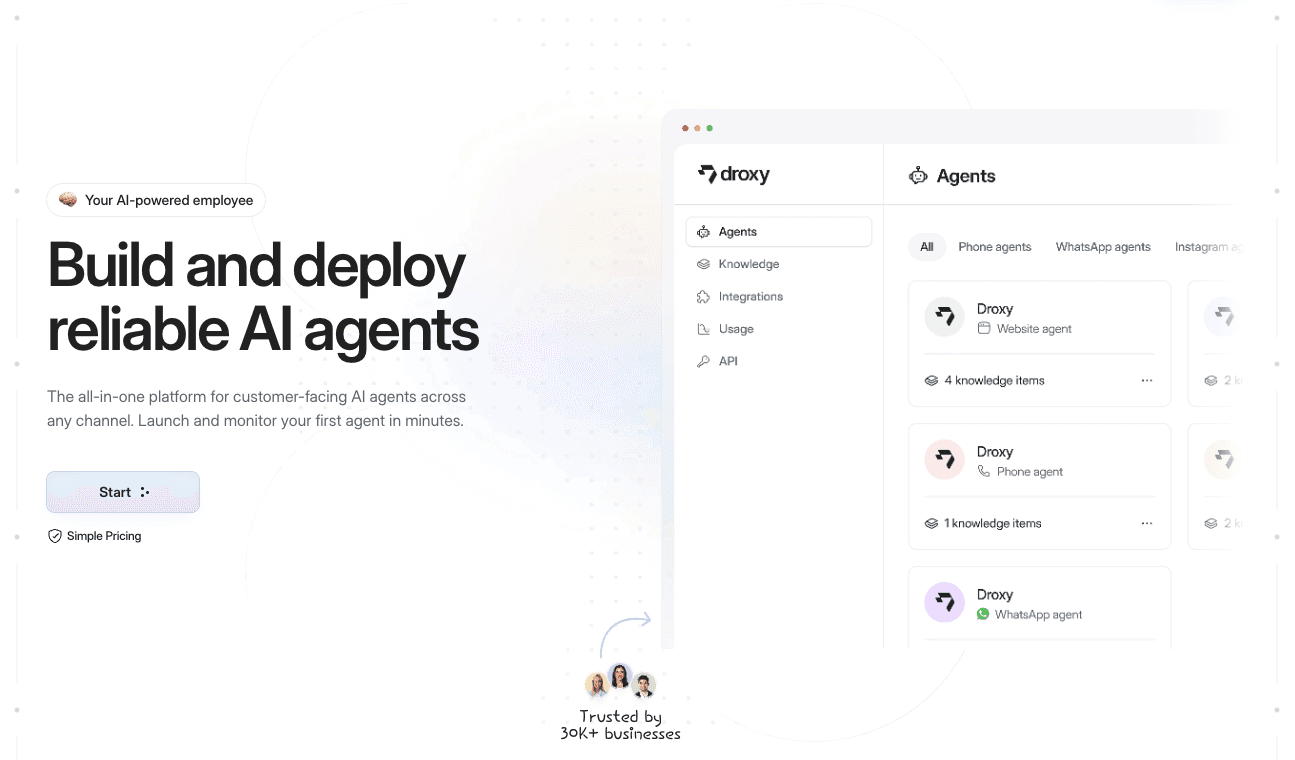
If you’re managing support across a website widget, a phone line, or WhatsApp, the persona and grounding rules you build once carry across all of them without rewriting from scratch. Agencies managing multiple client bots can do the same under their own brand. Plans start at $16 a month on the Basic tier, scaling up through Advanced and Enterprise as your channel and volume needs grow. Check the pricing page to find the plan that matches your current bot’s scope and start building.
Sources
For deeper technical grounding, see Google’s conversation design fundamentals, OpenAI’s prompt engineering guide, and Droxy’s own breakdown of how conversational AI works.
FAQ
What Is Chatbot Conversation Design?
Chatbot conversation design is the practice of planning how a bot understands, responds to, and recovers from user input across text, voice, and button-based interactions. It draws on linguistic principles like Grice’s Cooperative Principle to keep exchanges clear, relevant, and free of ambiguity, as outlined in Google’s conversation design guidance.
What’s the Difference Between Scripted and Generated Chatbots?
Scripted bots follow fixed decision trees with preset response branches, while generated bots use large language models to produce dynamic replies based on context. Both rely on the same design principles but need different tactics, scripted flows need exhaustive branch mapping, generated flows need grounding sources, according to Horizon Design System’s guidelines.
How Do I Reduce Chatbot Hallucinations?
Ground the model’s responses in a retrieval system (RAG) that pulls facts from a verified knowledge base rather than letting it answer purely from training data. Structuring prompts with clear identity, instructions, context, and example sections also anchors responses to trusted sources, per Google Cloud’s chat prompt documentation.
What Metrics Should I Track for Chatbot Performance?
Track task completion rate, fallback rate, turns per conversation, CSAT, and deflection rate as your core set. Pair those numbers with session replay and short user interviews to catch problems the metrics alone won’t reveal.
Does Droxy Support Both Scripted and AI-Generated Conversations?
Droxy is built around deploying AI powered agents with deep customization, letting teams set persona rules and grounding sources for generated conversations across website, phone, WhatsApp, Instagram, and Facebook channels. Current plans and features are listed on the Droxy pricing page.
Recommended
Chatbot conversation design is the practice of scripting and structuring how a bot talks, listens, and recovers from confusion across every channel it lives on. The single rule that matters more than any other: build every exchange around what the user is trying to accomplish, and never make them work to understand you. Get that right and the rest, tone, error handling, testing follows naturally.
TL;DR:
Scripted chatbots are ideal for narrow, predictable questions, while generated models excel with open-ended queries and knowledge-based reasoning.
Designing effective prompts involves clear structure, grounding sources, and iterative testing to prevent hallucinations and maintain response accuracy.
Continuous log review and fallback telemetry are crucial for improving chatbot performance over time, especially for handling ambiguous or repeated failures.
Using structured fallback strategies and human handoff reduces user frustration and enhances overall conversation quality.
Most teams benefit from a no-code platform that supports multi-channel deployment, real-time analytics, and easy iteration, such as Droxy.
Droxydroxy.aiDesign Better Conversations Across ChannelsDeploy customized AI agents across chat, phone, WhatsApp, social, and Shopify to provide instant answers in your brand voice.Explore Droxy
Table of Contents
What Chatbot Conversation Design Covers, and When to Use Which Approach
Core Principles Behind Every Good Chatbot Conversation
The Chatbot Design Process: From Research to a Shipped Bot
Chatbot Prompt Engineering: Structuring Instructions the Model Can Actually Follow
Designing Fallbacks and Human Handoff That Don’t Frustrate Users
What to Measure After You Ship a Chatbot
How Droxy Supports the Workflow Above
The Habit Most Teams Skip, and It’s the One That Matters Most
Try Droxy for the Channels Your Chatbot Needs to Cover
Sources
What Chatbot Conversation Design Covers, and When to Use Which Approach
Chatbot conversation design spans two fundamentally different build methods, and picking the wrong one wastes months. Scripted (rule-based) design relies on decision trees: a user picks from defined options, and the bot follows preset branches with no improvisation. Generated (AI-powered) design uses large language models to produce dynamic, context-aware responses that adapt to open-ended input.
Both approaches lean on the same core principles but demand different operational tactics. Scripted flows need airtight branch logic and exhaustive edge-case mapping; generated flows need grounding sources, prompt structure, and guardrails against hallucination, a distinction worth understanding before you commit to either, as Horizon Design System’s guidelines lay out clearly.
Chatbots today operate across a wide set of surfaces, each with its own constraints:
Website chat widgets, where users expect instant answers to product or support questions
Phone (voice) agents, where turn-taking and interruption handling matter more than visual UI
WhatsApp and Instagram/Facebook Messenger, where conversations are asynchronous and often transactional
Shopify and ecommerce storefronts, where the bot’s job shifts toward product discovery and cart recovery
Most business goals fall into three buckets: deflect repetitive support tickets, capture and qualify leads, or guide a purchase decision. If your use case involves a narrow, predictable set of questions (order status, store hours, appointment booking), a scripted flow is faster to ship and easier to audit. If users ask open-ended questions in their own words, or you need the bot to reason across a knowledge base, a generated approach with retrieval grounding performs better. For a deeper breakdown of how these two models diverge technically, see AI agent vs. chatbot.
Core Principles Behind Every Good Chatbot Conversation
Conversation design didn’t start with chatbots. It borrows directly from H.P. Grice’s Cooperative Principle, a set of linguistic maxims from the 1970s that describe how humans cooperate to make sense in dialogue. Google’s conversation design guidance builds its entire framework on four of Grice’s rules: be informative, be relevant, be clear, and avoid ambiguity. Translate those into bot behavior and you get a practical checklist.
Be informative means answering the actual question, not a nearby one. If a user asks “Can I return this after 30 days?” the bot shouldn’t reply with a generic returns policy link; it should answer yes or no first, then offer detail. Be relevant means cutting anything that doesn’t serve the user’s immediate goal, no filler greetings, no unnecessary disclaimers. Be clear means short sentences, no jargon, and one idea per message bubble. Avoid ambiguity means never leaving a user unsure whether the bot understood them.
Persona consistency matters just as much as linguistic clarity. A bot that’s playful in one reply and formal in the next reads as broken, not adaptive. Pick a voice, a friendly retail assistant, a no-nonsense scheduling tool, and hold it steady, adjusting only pace or formality when context genuinely calls for it (a billing dispute deserves a calmer register than a product recommendation), as detailed in how to humanize AI text with instructions.
Design affordances do heavy lifting too:
Quick-reply buttons reduce typing and cut ambiguity for common intents
Confirmation prompts before irreversible actions (canceling an order, deleting an account) prevent costly mistakes
Progressive disclosure, showing options in stages rather than dumping a full menu, keeps cognitive load low
Pro Tip: Read your bot’s scripted replies out loud. If a sentence sounds stiff or over-explained when spoken, a real user will find it just as awkward reading it.
Five elements show up across nearly every practical conversation-design framework: flow, persona, memory/context, error handling, and quick replies, as Jotform’s chatbot design guide notes. Miss any one and the whole experience feels incomplete, no matter how polished the individual replies are.
The Chatbot Design Process: From Research to a Shipped Bot
Good chatbot conversation design follows a repeatable sequence. Skipping steps to ship faster almost always costs more time later in rework.
Mine existing logs and run quick interviews. Pull transcripts from live chat, support tickets, or call center logs to find the actual phrases users type, not the phrases you assume they’ll type. Ten short user interviews often surface more intent variety than a month of guessing.
Map the flow before writing a single line of copy. Sketch every decision point, happy path, and dead end using a flowchart tool or even a whiteboard. Produce two artifacts: an intent list (what users want) and a flow diagram (how the bot responds at each branch).
Author scripts and persona rules together. Write sample dialogue for every major intent, then extract explicit rules from it: sentence length limits, banned words, how the bot refers to itself. Decide what grounding sources (product catalogs, FAQ documents, policy pages) each generated response can pull from.
Prototype fast, before writing production code. Tools like Voiceflow, Botsociety, or even a clickable Figma flow let you test conversation logic with five real users in an afternoon. Watch where they hesitate or rephrase; that’s where your flow breaks.
Launch small, measure immediately, and set an iteration cadence. Ship to a limited audience segment first. Review fallback rate and completion rate weekly for the first month, then move to a biweekly cadence once the bot stabilizes.
Pro Tip: Build your intent list from real transcripts before you write a single flow diagram. A bot designed from assumptions about what users will ask almost always underperforms one designed from what they actually asked.
This cycle never fully closes. Even mature bots need continuous log review, because new products, new policies, and seasonal spikes constantly introduce intents nobody scripted for. For teams building this from scratch, Droxy’s guide on building a conversational AI walks through the technical side of turning this process into a working agent.
Chatbot Prompt Engineering: Structuring Instructions the Model Can Actually Follow
Generated conversations live or die on how well the underlying prompt is built. A strong prompt for an LLM-driven agent typically has four components: identity (who the bot is and its role), instructions (what it should and shouldn’t do), context (business-specific knowledge it needs), and examples (sample exchanges that demonstrate tone and format).
Complex agents benefit from structured formatting, using clear delimiters or XML-like tags to separate these components so the model doesn’t blur developer instructions with user input. Anthropic’s prompting guidance recommends exactly this: wrapping instructions, context, and examples in distinct tags so multi-turn agentic behavior stays predictable instead of drifting.
Grounding is what keeps generated responses honest. Retrieval-augmented generation (RAG) lets the model pull facts from a trusted knowledge base at response time instead of relying purely on what it learned during training. Google Cloud’s documentation on chat prompts frames grounding and structured prompt components as the two most reliable levers for cutting hallucinations in production agents.
Practical steps that make this concrete:
Write an initial prompt, run it against ten realistic queries, and log where it fails before touching the wording again
Add one clarifying example at a time rather than rewriting the whole prompt when something breaks
Keep a versioned prompt repository so a regression can be traced back to the exact change that caused it
Separate “hard rules” (never quote a price without checking the catalog) from “style guidance” (keep replies under three sentences) in different prompt sections
Prompt engineering is inherently iterative. OpenAI’s own guidance describes it as part art and part science, precisely because model outputs are non-deterministic; the same prompt can produce slightly different phrasing across runs, so testing at scale matters more than testing once.
Designing Fallbacks and Human Handoff That Don’t Frustrate Users
Every chatbot fails eventually. What separates a good conversation design from a bad one is what happens in the next three seconds.
Generic fallback phrasing, “Sorry, I didn’t understand that,” offers the user nothing to work with. Contextual fallbacks reference what the bot did understand: “I caught that you’re asking about billing, but I’m not sure if you mean a refund or a charge dispute, which is it?” Google’s guidance on designing for the long tail recommends exactly this kind of lightweight recovery, patterns that nudge the conversation back on track without drawing attention to the failure itself.
Repair strategies worth building into every flow:
Clarify by asking a narrow follow-up question instead of repeating the same broad prompt
Simplify by offering two or three concrete options instead of an open text field
Escalate to a human the moment the bot detects repeated failed attempts or explicit frustration language
Handoff rules should be decided in advance, not improvised mid-conversation. Pass the full conversation transcript, detected intent, and any account or order data already collected, so the human agent never makes the user repeat themselves.
Pro Tip: *Track fallback frequency by intent, not just overall.
What to Measure After You Ship a Chatbot
Testing chatbot conversation design means combining hard numbers with direct observation of real sessions. Rasa’s guidance on designing chatbot conversations recommends pairing quantitative metrics with qualitative review methods like session replay and structured interviews, rather than relying on either alone.
Metric | What it tells you | How to act on it |
|---|---|---|
Task completion rate | Whether users finish what they started | Rework flows below your target threshold first |
Fallback rate | How often the bot fails to understand | Flag any intent above your normal baseline for a prompt or flow fix |
Turns per conversation | Whether the bot is efficient or looping | Investigate flows with unusually high turn counts |
CSAT (post-chat rating) | Perceived quality, independent of completion | Cross-reference low scores against transcripts |
Deflection rate | Volume of tickets resolved without a human | Track alongside CSAT so speed doesn’t come at the cost of quality |
Run structural changes (a new flow branch, a rewritten prompt) as staged rollouts to a small percentage of traffic before a full release. Use A/B tests specifically for wording changes, comparing two prompt variants against completion rate rather than guessing which “sounds better.” Session replay and short user interviews catch what metrics miss entirely, moments of hesitation, rereading, or abandoned typing that never show up in a dashboard.
Turn what you find into a prioritized backlog ranked by fallback volume multiplied by how business critical the intent is. A low-traffic intent with a high fallback rate matters less than a high-traffic one with the same problem.
How Droxy Supports the Workflow Above
Everything covered so far, mapping flows, grounding responses, testing fallback rates, needs a platform that can actually execute it without a development team behind every change. Droxy is built as a no-code platform for deploying AI agents across website chat, phone, WhatsApp, Instagram, and Facebook, with deep customization so the persona rules and grounding sources described above stay consistent channel to channel.
Its analytics dashboard tracks the kind of completion and fallback signals this article recommends monitoring, and human handoff is built in for the moments a bot should escalate rather than guess. For teams training a bot on existing knowledge bases, Droxy’s conversational AI training guide walks through connecting those grounding sources directly.
The Habit Most Teams Skip, and It’s the One That Matters Most
Most teams treat chatbot conversation design as a writing exercise. Get the copy right, ship it, move on. That’s backwards. The bots that actually improve over time are the ones where someone owns fallback telemetry weekly, not quarterly, and treats a spike in “I didn’t understand that” as a bug report, not background noise.
The second mistake is chasing a perfect launch. A minimal bot that handles your top five intents well beats an ambitious one that handles fifty intents poorly. Ship the narrow version, watch what breaks, expand from there.
The third habit worth stealing: write persona rules as explicit constraints, not just sample dialogue. “Never use exclamation points” is a rule a writer can follow consistently. “Sound friendly” is a vibe that drifts across every new person who touches the script.
— Elena
Try Droxy for the Channels Your Chatbot Needs to Cover
Droxy is built for the exact workflow this article walks through: no-code multi-channel agents, real-time analytics for tracking completion and fallback rates, and human handoff for the moments a script shouldn’t handle alone. Instead of stitching together separate tools for website chat, phone, and WhatsApp, Droxy lets you design the conversation once and deploy it everywhere your customers already are.
If you’re managing support across a website widget, a phone line, or WhatsApp, the persona and grounding rules you build once carry across all of them without rewriting from scratch. Agencies managing multiple client bots can do the same under their own brand. Plans start at $16 a month on the Basic tier, scaling up through Advanced and Enterprise as your channel and volume needs grow. Check the pricing page to find the plan that matches your current bot’s scope and start building.
Sources
For deeper technical grounding, see Google’s conversation design fundamentals, OpenAI’s prompt engineering guide, and Droxy’s own breakdown of how conversational AI works.
FAQ
What Is Chatbot Conversation Design?
Chatbot conversation design is the practice of planning how a bot understands, responds to, and recovers from user input across text, voice, and button-based interactions. It draws on linguistic principles like Grice’s Cooperative Principle to keep exchanges clear, relevant, and free of ambiguity, as outlined in Google’s conversation design guidance.
What’s the Difference Between Scripted and Generated Chatbots?
Scripted bots follow fixed decision trees with preset response branches, while generated bots use large language models to produce dynamic replies based on context. Both rely on the same design principles but need different tactics, scripted flows need exhaustive branch mapping, generated flows need grounding sources, according to Horizon Design System’s guidelines.
How Do I Reduce Chatbot Hallucinations?
Ground the model’s responses in a retrieval system (RAG) that pulls facts from a verified knowledge base rather than letting it answer purely from training data. Structuring prompts with clear identity, instructions, context, and example sections also anchors responses to trusted sources, per Google Cloud’s chat prompt documentation.
What Metrics Should I Track for Chatbot Performance?
Track task completion rate, fallback rate, turns per conversation, CSAT, and deflection rate as your core set. Pair those numbers with session replay and short user interviews to catch problems the metrics alone won’t reveal.
Does Droxy Support Both Scripted and AI-Generated Conversations?
Droxy is built around deploying AI powered agents with deep customization, letting teams set persona rules and grounding sources for generated conversations across website, phone, WhatsApp, Instagram, and Facebook channels. Current plans and features are listed on the Droxy pricing page.
Recommended


🚀
Powered by Droxy
Turn every interaction into a conversion
Customer facing AI agents that engage, convert, and support so you can scale what matters.
✨
Learn more
Recent posts
Insights
3 min read
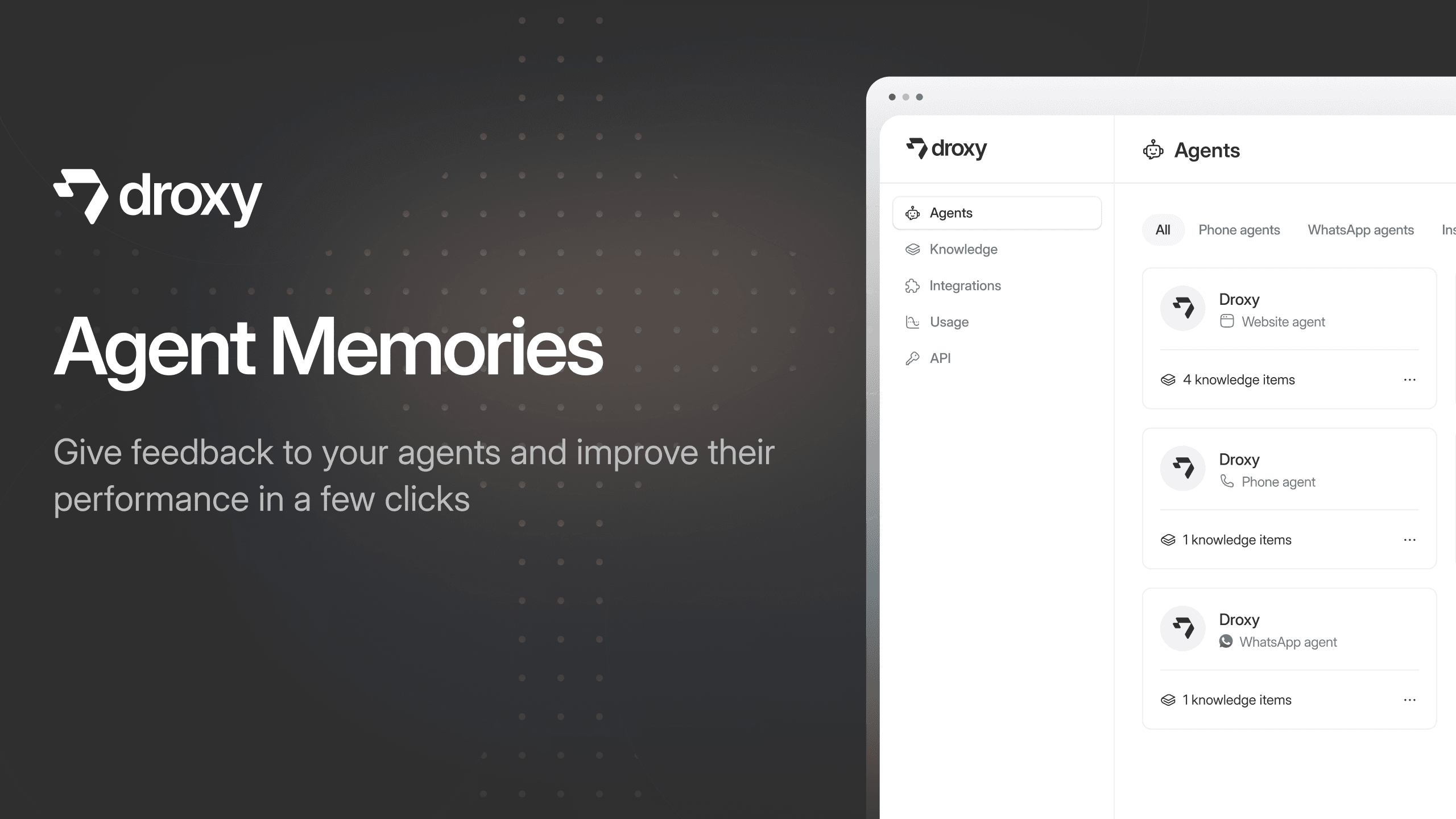
Introducing Agent Memories
Improve your agents' performance with Agent Memories. Prevent agents from repeating the same mistakes by giving them feedback.
Read more

Insights
15 min read
HVAC Marketing in 2025: The Definitive Lead Gen Guide
Discover 15 proven HVAC marketing strategies, plus learn how Droxy's AI website agent converts curious visitors into qualified leads by answering their questions instantly - right when they're most interested in your services.
Read more

Insights
10 min read
10 Best AI Sales Agents in 2025: Tested & Ranked
Discover the top 10 AI sales agents of 2025, designed to enhance lead generation, personalize outreach, and ultimately, close more deals
Read more
Insights
3 min read
Introducing Agent Memories
Improve your agents' performance with Agent Memories. Prevent agents from repeating the same mistakes by giving them feedback.
Read more
Insights
15 min read
HVAC Marketing in 2025: The Definitive Lead Gen Guide
Discover 15 proven HVAC marketing strategies, plus learn how Droxy's AI website agent converts curious visitors into qualified leads by answering their questions instantly - right when they're most interested in your services.
Read more